Vasco Rossi, 'Doctor' of Communication: Salerno recognizes a language that has spanned generations.
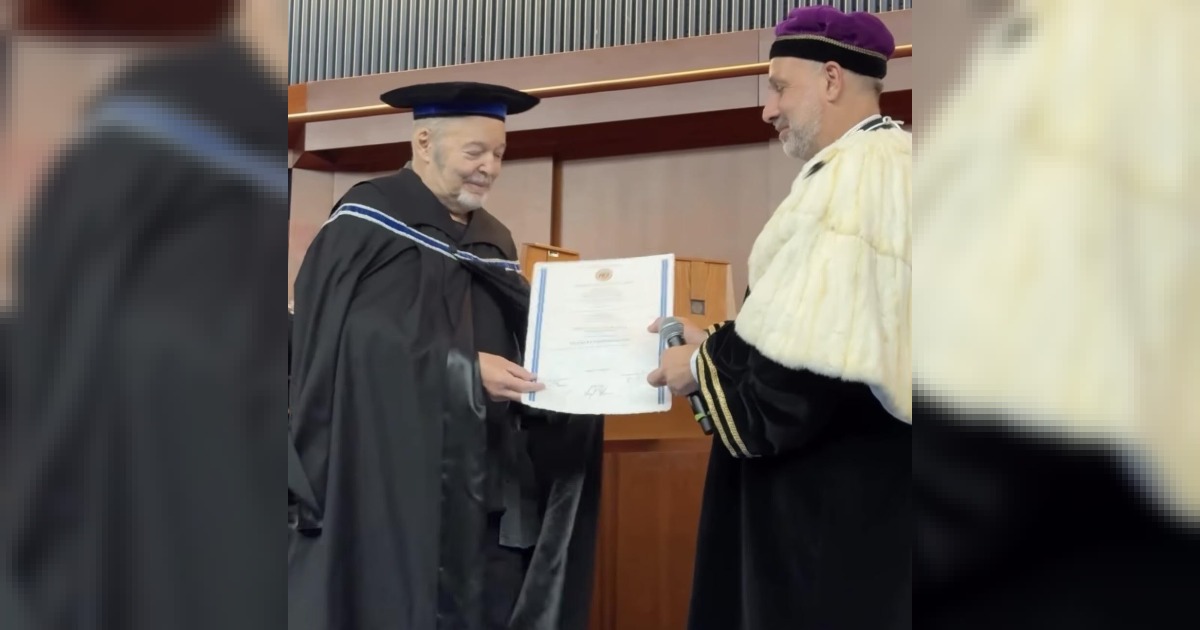
Vasco Rossi receiving an honorary degree from Rector Virgilio D'Antonio (photo by Ezio Cairoli)
Nearly fifty years after the beginning of his artistic career, Vasco Rossi returns to a university. But this time, not simply to recount his career, nor to celebrate the achievements of a discography that has spanned generations.
In Fisciano, on the campus of the University of Salerno, the rocker from Zocca received an honorary doctorate in Politics and Communication. This award formally brings his name into the academic world, but above all, it certifies a precise understanding of the Vasco phenomenon: that of an artist who, over time, has built a recognizable language and a relationship with his audience that has itself become a subject of study.
So it's not just the singer who arrives in the university classroom. It's the character, the symbol, the lexicon, the imagery constructed through thousands of concerts, songs, interviews, provocations, and reflections.
It's that "Vasco" that millions of people recognize even before a song begins.
«I didn't study politics and communication in books»
Vasco, of course, does not give up his figure.
During his lecture, he recalls having studied Economics and Commerce and ironically admits that he hadn't studied politics and communication from books.
“I have experienced them, I have suffered them and sometimes, I admit, I have even provoked them,” he says.
His university, after all, was another: that of stages, squares, protests, records sold, relationships with the public and a communication often built precisely through breaking the mold.
And there's one passage that sums up the surprise at the recognition better than any other: "I wrote songs. After almost fifty years, I'm discovering they can even become a degree thesis. How wonderful!"
There's much more to this joke than a provocation. It's the awareness that a popular song, once it's embedded in the collective memory, can transcend mere entertainment and become a cultural document.
The irony of unanimity: "Me? I've always been divisive."
The most instinctively "Vascian" moment comes when the rocker says he learned that the awarding of the doctorate had been voted unanimously.
The reaction is one his audience knows well. "Unanimously? Me? I've always been considered divisive. I thought: Was it possible there wasn't even one person against it?"
A joke that draws applause, but also opens up a less light-hearted reflection.
For decades, Vasco was an artist capable of dividing, provoking, and shocking, but also of capturing deeply shared sentiments. His career unfolded precisely along this contradiction: being perceived as a voice of transgression and, simultaneously, becoming a familiar figure across generations.
And it is perhaps precisely this ability to transform contradiction into language that has contributed to his longevity.
The unanimous recognition thus becomes, in the singer-songwriter's words, a small lesson in the value of knowledge. "Study and knowledge open minds and truly free one from ignorance and prejudice," he emphasizes.
From "divisive" rocker to cultural phenomenon
The inevitable question that accompanies the award is: why would a university award a doctorate in Politics and Communication to a singer?
The answer lies precisely in the object of the research. Vasco isn't just a songwriter. Over the decades, he has developed a precise communication code: a set of instantly recognizable words, expressions, images, and attitudes.
Fragility, loneliness, desire, love, disillusionment, fear, the will to live, freedom. These are some of the emotional realms in which his repertoire has built a particularly strong connection with listeners.
His songs have become a sort of sentimental archive in which different generations have found words to express themselves. And it is precisely here that the musical phenomenon becomes a communicative phenomenon.
A song is born from the voice and sensitivity of its writer. But when it enters the lives of others, it changes ownership. "When a song enters the lives of others, it no longer belongs solely to the person who wrote it." This is one of the central concepts of Vasco's reflection.
When a song becomes absorbed into the daily lives of its listeners, it takes on new meanings. It becomes the soundtrack to a love story, a breakup, a journey, a party, a bereavement, a difficult night.
"When a song enters the lives of others, it no longer belongs solely to the person who wrote it," he observes. This, according to the singer-songwriter, "is its strength and also its risk."
Because public speech is never neutral.
A phrase can be interpreted, distorted, repurposed. It can become a slogan, a newspaper headline, a phrase repeated on social media, a thought used by someone else to describe their experience.
Communication, therefore, doesn't end when the author utters a sentence. It begins right there. The word as a weapon: to build or to destroy. This is probably the most political passage of the lecture.
Vasco talks about the word as a very powerful tool.
It can manipulate, simplify reality, create enemies, and stoke fears. But it can also give voice to those who can't be heard, counter arrogance, and champion tolerance and inclusion.
A reflection that goes far beyond the realm of music. In the age of constant communication, where a sentence spoken in front of a camera can reach thousands or millions of people in a matter of minutes, the speaker's responsibility becomes crucial.
"Every word creates a climate," Vasco claims. It can fuel "cynicism or trust, hatred or confrontation, resignation or the desire to react."
It's a reflection that concerns the singer, but also the politician, the journalist, the influencer, the television personality and anyone who today has the opportunity to speak to a potentially huge audience.
Even silence communicates
Vasco expands his reasoning further. It's not just what's said that communicates. It also communicates what's left unsaid. "Silence also communicates," he explains.
And even a seemingly harmless joke can have consequences when delivered in front of a large audience.
The problem, then, isn't just having a voice. It's understanding the weight of that voice.
"Being listened to doesn't mean always being right," the rocker observes. It means knowing that what's said can be taken up, interpreted, and transformed.
It is here that the figure of Vasco Rossi, studied at the university, takes on a broader dimension than just music. His relationship with the public becomes a laboratory for contemporary communication.
Rebellion according to Vasco: not just saying "no"
Another central element of his reflection concerns the word "rebellion." For Vasco, rebellion doesn't simply mean opposition. Above all, it means rejecting prepackaged words, imposed identities, and easy answers.
"Rebellion isn't just saying no," he claims. It's finding a personal way to live with reality and, when necessary, trying to change it. It's a definition that allows us to reinterpret a significant portion of his artistic output in a different light.
Behind the provocation, the transgression, and the direct language lies a constant search for individual identity.
The right to be vulnerable without shame. The right to admit your own contradictions. The right not to necessarily conform to others' expectations.
This is one of the reasons why Vasco's language has managed to survive the passage of generations.
The second academic recognition
This isn't the first time Vasco Rossi has officially entered the academic world. In 2005, he received an honorary degree in Communication Sciences from IULM University in Milan.
Today, over twenty years later, the University of Salerno adds a new recognition. The difference, however, also lies in the time that has passed.
Meanwhile, the Vasco phenomenon has further consolidated. The original audience has grown with him, while new generations have begun to listen to those same songs.
It is precisely this ability to transcend time that represents one of the most interesting aspects from a communicative point of view.
Fifty years later, audiences continue to change
The most significant fact is not only that Vasco still has a huge audience.
The fact is, that audience isn't made up of just one generation. In Fisciano, on the day of the ceremony, there were both young people and older people. A diverse audience, coming to see the singer but also the figure who, for many, has been a part of their lives.
The wait on campus is punctuated by his songs, until the arrival of "Stupendo." It's a scene that perfectly captures the paradox of academic recognition: the university studies the phenomenon, while the phenomenon continues to occur in front of the university.
«I will continue to perform concerts»
And Vasco doesn't seem inclined to become a monument. His academic title doesn't change his identity. "I'll continue to perform," he assures.
2026 brought him back on stage with a setlist full of surprises. Among them was "Marea," a 1996 song never before performed live and included in the tour's repertoire.
It's a seemingly minor detail, but it once again speaks to the special relationship between Vasco and his audience: even after decades, there are songs to rediscover, meanings to recirculate, pieces of the past to bring into the present.
The university opens its doors to popular culture
The rector of the University of Salerno, Virgilio D'Antonio, emphasizes the significance of the day.
The goal is not only to celebrate a famous artist, but to demonstrate that the university can engage with forms of knowledge born outside the classroom.
Popular music, when it achieves such a capacity to influence the collective imagination, becomes a subject of analysis.
And Vasco's case is particularly interesting precisely because his communication didn't remain confined to music. It became a social language.
Vasco's true "doctorate": having transformed his experience into language. Ultimately, Salerno's award seems to encompass precisely this element. Vasco Rossi doesn't receive the title because he sold a lot of records or filled stadiums.
He received his doctorate because, over the course of nearly half a century, he has built a form of communication capable of transforming individual experiences into collective feelings.
He gave words to fragility. He transformed rebellion into identity. He made contradiction a personal signature. He built a relationship with the audience in which the artist speaks and the listener recognizes themselves.
And above all, it demonstrated that the most powerful communication is not necessarily the most sophisticated.
Sometimes she is the one who manages to pronounce, in simple words, something that millions of people already felt inside themselves but had not yet been able to say.
Perhaps this is precisely the reason why, today, at the University of Salerno, Vasco Rossi can joke about the title of "doctor" without ceasing for an instant to be Vasco.
Because his true academic title, the one earned on the field, has been written for almost fifty years in the words that his audience continues to sing along with him.
Breaking News
Today's horoscope for October 8, 2026, by Paolo Tedesco
Saturn and Jupiter are in an excellent position, but the transit is defined as "capitalist"... everyone favors... Read more
Prysmian is seeking line workers and engineers in Campania: both fixed-term and permanent positions available.
Prysmian is looking for new staff in Campania: line and logistics workers in Pignataro Maggiore and… Read more
Leonardo launches 49 new selections in Campania: networks enter Pomigliano d'Arco and Napoli-Fusaro
Leonardo is opening new opportunities in Campania: 49 technology and engineering positions in Pomigliano d'Arco… Read more
Frattamaggiore, petition against violent nightlife: "More weekend patrols."
Frattamaggiore - Increased security, constant checks, and greater coordination between law enforcement agencies during… Read more
He stole Asia Argento's daughter's cell phone and released a private video: it was found in Naples.
Naples - An argument that ended badly, and then the act of revenge… Read more
Unipegaso in the turmoil: executives, editors, and journalists under investigation. The shadow of pressure casts over Minister Bernini.
Naples – A dense network of pressures, attempts at political and institutional influence, and maneuvers in the world… Read more

National Newspaper
Registration No. 1301 of 2016 – ROC 030531
Director: Giuseppe Del Gaudio
To contact the editorial staff click HERE |
Download our Official ANDROID APP
