Pompeii, an app to see the ancient city with augmented reality: free until July
June 23, 2026 - 20:58 pm

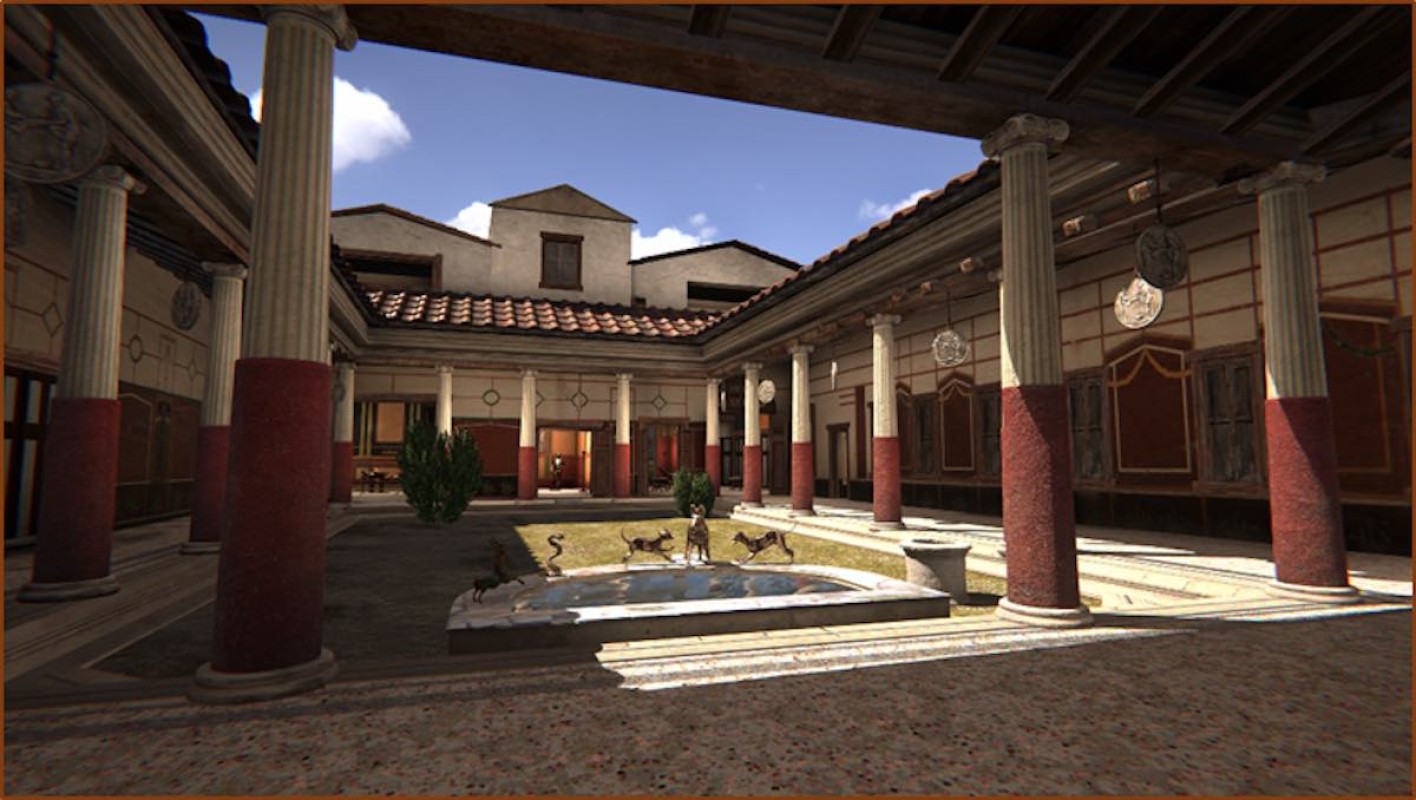
The Citharist's house reconstructed with augmented reality
Pompeii – Strolling through the ancient city as if it were 79 AD is now possible. Augmented reality is coming to the Pompeii excavations with the Portyl app.
The technological innovation and immersive fruition project has been implemented in the archaeological site and will be available from tomorrow 24 June in the Citarista's house, one of the largest in Pompeii and the first to be involved in the experimentation of archaeology of the future: a place where research, reconstruction, and narration merge to bring an ancient space back to life.
Inside the house, famous for the statue of Apollo Citharist– Hence the name of the residence—visitors will be able to observe digitally reconstructed rooms, furnishings, and scenes of daily life. But the experience isn't limited to this building: iconic sites such as the Forum, the Amphitheater, the Teatro Grande, and the Odeon (Teatro Piccolo) also become visible in augmented reality, offering an immersive journey into the heart of the ancient city.
Portyl, an App to rebuild the house and experience the places
The Portyl app will allow visitors to experience historic sites as they appeared during their heyday, using an iPhone, Android smartphone, or tablet. Through detailed and historically accurate digital reconstructions, visitors will be able to freely explore each location, observing not only the architecture, but also the people, animals, and events that once brought these spaces to life.
Visitors can witness moments of Pompeii life, such as gladiatorial combats in the Amphitheater, performances in the Teatro Grande and the Odeon, and the eruption of Vesuvius. At the House of the Citharist, visitors can immerse themselves in daily life within the domus and its surroundings.
Every site within Pompeii has been meticulously scanned, thoroughly researched, and painstakingly recreated by a team of artists at History Inc.
Visitors can download the Portyl app for free using QR codes located at the three entrances to the Park, or in the areas included in the experience, which direct them to the App Store or Play Store.
Portyl will be free for all visitors until July 15, 2026. After that, three free features will be available within the app: the Basilica (near the Forum), the Quadriportico, and the exterior of the Amphitheater. All other immersive features will be available for a fee, costing €15,00. The sites included in the complete experience are: the Forum, the House of the Citharist, the Teatro Grande, the Odeon, and the Amphitheater.
Additionally, at the ticket office, bookshop, and info points managed by Opera Laboratori Fiorentini, it will be possible to rent a tablet for €20,00, including the Portyl app with all content fully unlocked, allowing even visitors without a compatible device to access the immersive experience.
Portyl uses a system of geofencing based on the GPS signal to recognize the physical presence of the visitor within the enabled areas.
This technology allows for extremely precise alignment between the reconstructed environments and the actual location, allowing for seamless use. In just a few seconds, the visitor is virtually positioned where they are physically located, allowing them to observe the reconstructed historical setting brought to life.
To encourage wider use, the app will also be available outside of Pompeii.
Gabriel Zuchtriegel: “It is not just a digital project but a new way of understanding archaeology
This isn't just a digital project, but a new way of understanding archaeology. "The introduction of artificial intelligence and digital technologies marks a crucial step. These tools are destined to revolutionize the protection, research, and enjoyment of cultural heritage. However, this revolution isn't neutral," explains Park Director Gabriel Zuchtriegel. "Its outcome depends on how we use them.
AI represents an extraordinary opportunity if geared toward the democratization of knowledge, making complex and often difficult-to-understand content accessible to all. It can broaden audiences, engage new generations, and break down cultural and physical barriers.
At the same time, there's a risk that technology will become locked into a self-referential cycle, producing content for its own sake, without any real connection to scientific research or authentic heritage. This is precisely where archaeology's role comes in.
Archaeologists must not become passive spectators of machines that process data and reconstructions, but conscious directors of the transmission of heritage. The challenge is to guide these technologies, ensuring that each digital reconstruction is based on solid, verifiable, and shared foundations, maintaining a balance between spectacularity and scientific rigor.
Inclusion and creativity in the Citarista's House
Furthermore, with the opening of the Casa del Citarista, Parvula Domus—the Park's cultural and social farm, managed by the "Il Tulipano" cooperative—continues its commitment to fostering inclusion and creativity within the archaeological site of Pompeii. Every Wednesday starting July 1st, the Parvula Domus youth will welcome the public for a guided tour of the rooms and workshops related to the house's themes.
The "mystery" of the statue of Apollo Citarista and new hypotheses on the history of the Citarista's house
The augmented reality project is based on multidisciplinary research on the Citharist's house, which was excavated starting in 1853 and is now difficult to understand, since many frescoes and artifacts were taken to the Naples Museum, as was customary at the time.
The results of the research coordinated by Director Zuchtriegel have been incorporated into a new digital model of the house, developed in collaboration with a research team led by Francesco Colace of the Department of Industrial Engineering at the University of Salerno and Luisa Ferro of the Faculty of Architecture at the Polytechnic University of Milan. The model was built with the help of artificial intelligence (AI) tools and provided a scientific basis for the app now available to the public.
Furthermore, a book has been published entitled The Apollo of Pompeii: Reconstruction of a Classical Masterpiece, edited by the director and with an appendix by collaborators Anna Civale and Alessandro Russo, printed by Giunti and Sillabe as concessionaires of the Pompei publishing service.
All Rights Reserved
Published by
June 23, 2026 - 20:58 pm
Breaking News
Phlegraean Fields, Fico: "A specific measure has been agreed with the government."
A measure entirely dedicated to the Phlegraean Fields, with comprehensive measures to address the needs of… Read more
24 September 2026 - 19:05
Campi Flegrei, Mayor Manzoni: "We will no longer tolerate humiliation. Now, only facts matter."
"We can no longer afford to waste time." The mayor of Pozzuoli, Luigi Manzoni,… Read more
24 September 2026 - 18:53
Medical Device Payback: "Medtech Payback" Arrives: Broya de Lucia's investigative book
ROME. Medical device payback becomes an investigative book. The book, titled "Medtech Payback,"… Read more
24 September 2026 - 18:29
Grumo Nevano: Police raid identifies 176 people and issues fines exceeding €6.000.
A territorial control raid in Grumo Nevano: identifications, seizures, and administrative sanctions for violations... Read more
24 September 2026 - 17:45
Marco Travaglio tonight at the Teatro al Borgo in Casertavecchia
Marco Travaglio brings Cornuti e contenti to the Borgo di Casertavecchia as part of the 54th September at… Read more
24 September 2026 - 17:10
Fire on Via Nuova delle Brecce: Dioxin levels below the reference value
Data updated yesterday morning show 0,082 pg/Nm3 I-TEQ, below the value… Read more
24 September 2026 - 15:58

National Newspaper
Registration No. 1301 of 2016 – ROC 030531
Director: Giuseppe Del Gaudio
To contact the editorial staff click HERE |
Download our Official ANDROID APP