Pompeii, the skeleton of an equine emerges in the Chaste Lovers complex

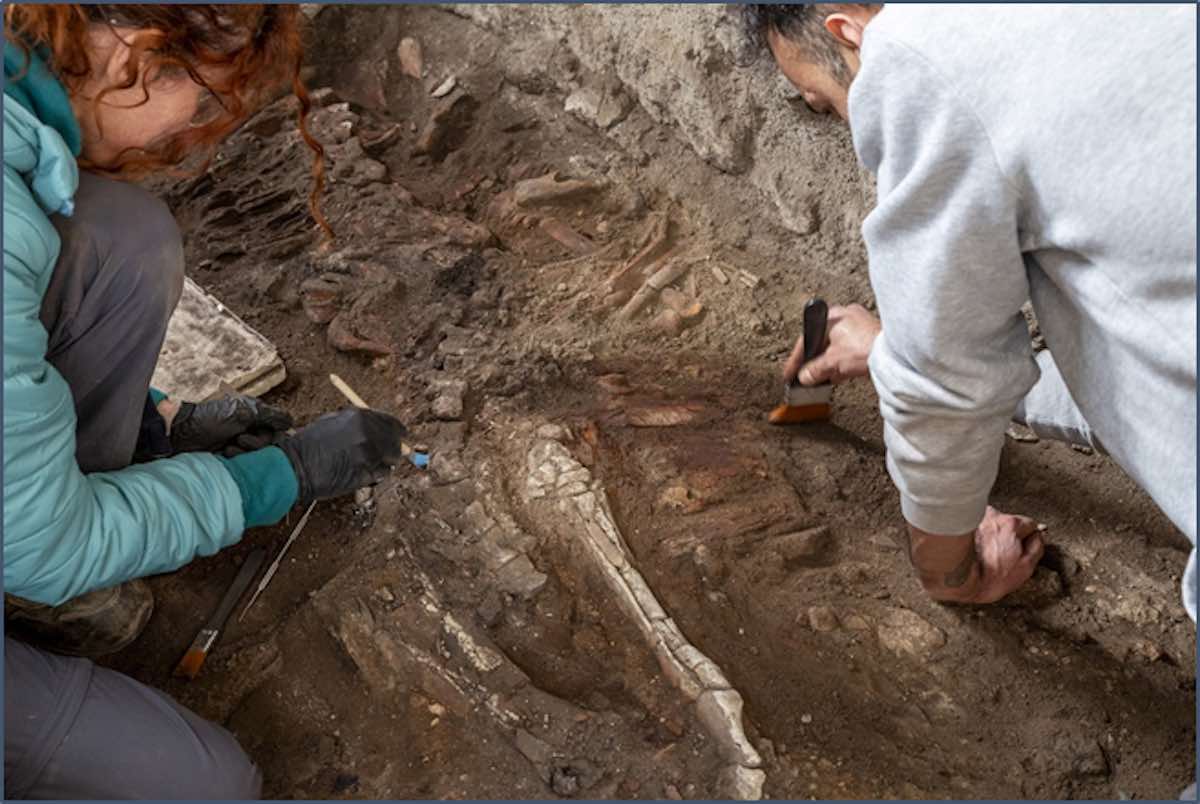
Skeleton found in the Chaste Lovers complex
Pompeii – Yet another snapshot of the eruption of Vesuvius in 79 AD was discovered during excavation work in the Chaste Lovers complex in the archaeological area of Pompeii, in a room once used for bread-making.
Not only petrified human skeletons but also those of animals used in excavation work are among the remains unearthed in ancient Pompeii. The skeleton of an equine, a horse, or a donkey, has resurfaced thanks to the collaboration between archaeologists and specialists from the Applied Research Laboratory—archaeozoologists, archaeobotanists, and anthropologist—as part of an interdisciplinary effort that represents one of the most significant aspects of archaeological research today.
Zoological archaeology allows us to reconstruct the ways in which animal species were exploited in the ancient world, offering valuable insights into production systems and the role animals played in daily life. The Insula dei Casti Amanti is one of the most important sites in Pompeii, preserving an entire production facility with a kiln, warehouses, and processing areas, as well as the owner's residence.
The complex, famous for the fresco of the "chaste kiss" found in a triclinium of the residence and which gives its name to the entire block, includes a large bakery with attached stables, where other horses had already been found in the past, used to power the millstones and transport the grain needed to make bread.
The excavation represented the first phase of the investigation, followed by initial studies on the materials found. Laboratory analyses, still ongoing, will allow for the collection of further data both on the animal's function within the production context and on its conditions at the time of the Vesuvius eruption in 79 AD.
Director Gabriel Zuchtriegel: "Not only splendid frescoes but also a study of ancient animals."
"For a long time," says director Gabriel Zuchtriegel, "Pompeii represented above all the beauty of its frescoes, the opportunity to study the material culture of antiquity. In reality, it is much more: it is the opportunity to learn about the human lives that were lost during the eruption, as in the recent exhibition of casts of the victims here in Pompeii, but also about the lives of animals.
In this case, an equine, a horse or a donkey, was found inside a house containing beautiful frescoes, the House of the Chaste Lovers. The Domus also served as a bakery and a mill. There was a stable where, in the past, several animals were found. But recently, during new excavations, another animal was discovered, an equine, which had escaped and was found in another room.
"This means more research not only on human victims, but also on animals, to understand how animals and humans lived and worked together in the society of about two thousand years ago," adds Zuchtriegel. "The excavation of this equine in the Chaste Lovers complex is also an excellent example of the multidisciplinary work that takes place at the site every day: archaeologists and specialists from different disciplines collaborate to reconstruct not only the objects, but the relationships between people, animals, and productive spaces. The analyses are still ongoing and will provide us with further information: the site continues to offer material of great scientific value."
The dynamics of the eruption and the reactions of animals during the catastrophe
The study of the equine may also contribute to the understanding of the eruptive dynamics and the animals' reactions to the catastrophic events that struck the city, adding another piece to the reconstruction of those dramatic hours. It demonstrates how Pompeii offers an extraordinarily preserved context, allowing for a systematic investigation of ancient life, reconstructing the relationships between spaces, productive activities, individuals, and animals. Research continues through study of the artifacts and laboratory investigations, in an ongoing dialogue between different disciplines, to restore voice to even the most silent remains and to remind us how every testimony—human or animal—holds a story yet to be brought to light.
Breaking News
NOS intervention in Salerno: two restaurants closed due to illegal work and serious hygiene and sanitation deficiencies.
Two restaurants in Salerno were closed following inspections by the NOS, in collaboration with… Read more
Camorra, the Toiano District massacre: here's how informants framed the killers of the Phlegraean feud.
The shadow of the past resurfaces: the night of the Toiano district. It was the 19th... Read more
Recruiting Day in Castellammare di Stabia: 227 open positions for 54 profiles, at 28 companies on October 16th.
A Recruiting Day is being held in Castellammare di Stabia, bringing together approximately 28… Read more
Apple is seeking four IT-Retail positions in Campania: sales, expert, technician, and manager.
Apple is opening four IT-Retail positions in Campania: sales, expert, technician, and manager. 40-hour workweeks,… Read more
Public competition for 6 Administrative Referendaries at the General Secretariat of the Presidency of the Republic (Rome)
Public competition for 6 probationary administrative referees at the General Secretariat of the Presidency of the Republic:… Read more
Brusciano opens 7 permanent positions: officials, instructors, and security personnel.
The Municipality of Brusciano, in Campania, is advertising seven permanent positions for administrative positions,… Read more

National Newspaper
Registration No. 1301 of 2016 – ROC 030531
Director: Giuseppe Del Gaudio
To contact the editorial staff click HERE |
Download our Official ANDROID APP