Gragnano, a canning plant seized: "Waste and purification plant irregular."

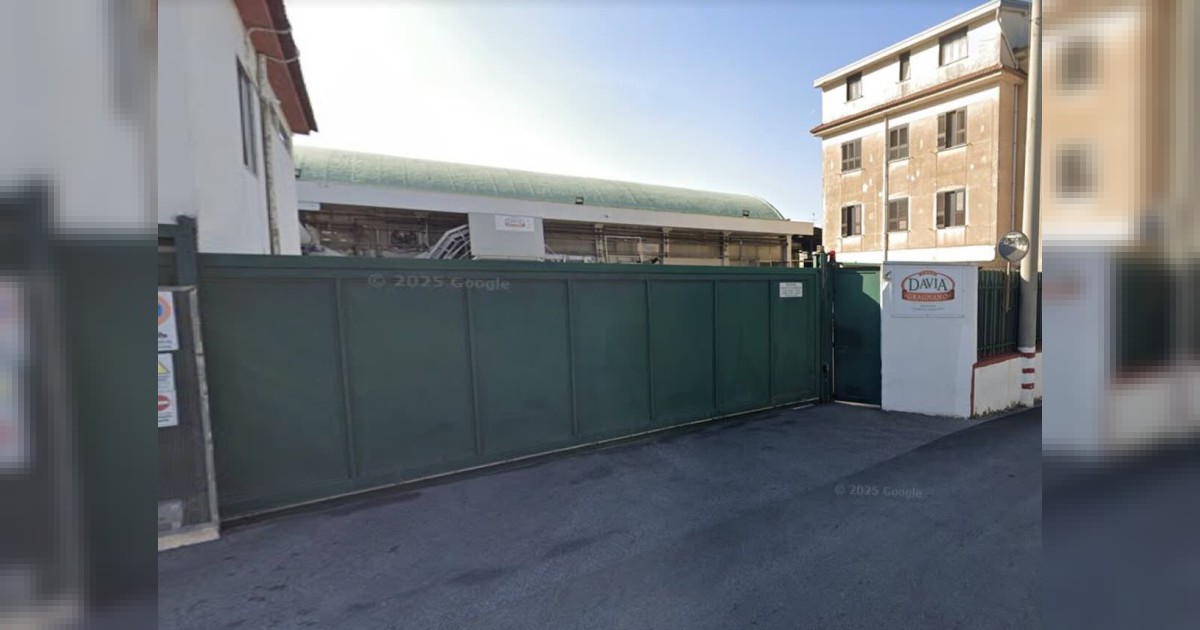
The seized factory
An industrial plant belonging to Davia Spa, a Gragnano-based company specializing in the production of canned food, has been placed under preventive seizure by the Carabinieri of the Naples Environmental Protection Group and the Provincial Command.
The measure was executed pursuant to a decree issued by the preliminary investigations judge of the Torre Annunziata Court, at the request of the Oplonti Public Prosecutor's Office, as part of an investigation into alleged violations of environmental regulations.
The charges concern, among other things, the lack of an environmental permit and the abandonment or illegal management of hazardous and non-hazardous special waste, as reported in the seizure decree.
Hazardous and non-hazardous waste
The checks were conducted by the military of the NOE of Naples, with the technical support of ARPAC, through a series of inspections of the plant.
The investigations focused on the company's production cycle and, in particular, the management of industrial wastewater, waste, and atmospheric emissions.
During the inspections, according to the investigation, critical issues emerged in the management of hazardous waste. Among the waste classified as hazardous are disinfectants, used mineral oils, and empty containers containing residues of hazardous substances. Non-hazardous waste, however, appears to include plastic and cardboard packaging and sludge from wastewater treatment.
According to investigators, the various materials were apparently piled up and stored directly on the ground, without adequate protection systems against accidental spills.
The purifier is also under examination
The system used to treat industrial wastewater also ended up in the crosshairs of the investigations.
The Carabinieri reportedly found a different configuration of the sewage treatment plant than that shown in the plan attached to the AUA, the Single Environmental Authorization. Specifically, they reportedly found fewer sedimentation tanks than required by the authorization.
A circumstance that, according to the reconstruction contained in the precautionary measure, would have contributed to outlining a picture of alleged irregularities in the environmental management of the plant.
Doubts about the environmental authorization
Another chapter of the investigation concerns the urban planning and construction situation of the production complex.
According to investigators, the plant is located partly within an agricultural area of particular scenic importance and is also comprised of a series of buildings that, according to the prosecution's hypothesis, were constructed over time without the necessary building permits and landscape authorizations.
This raises the issue of the validity of the AUA. The seizure order claims that the authorization was issued without prior verification of the urban planning and building code compliance of the entire production complex.
According to the Prosecutor's Office's findings, the Metropolitan City of Naples expressly indicated this verification as a necessary condition for issuing the permit, requesting the Municipality to certify the urban planning and construction compliance of the entire facility. This request, according to the investigation documents, was not responded to.
The investigation of the Sarno basin
The seizure of the Gragnano plant is part of a broader environmental monitoring effort on companies located in the Sarno River basin.
The investigation involves the Carabinieri for Environmental Protection and Energy Safety, the Carabinieri Forestry Corps, the Coast Guard, and the Metropolitan City of Naples Police, with the technical support of ARPAC and coordination by the Public Prosecutor's Offices of Avellino, Nocera Inferiore, and Torre Annunziata.
The initiative stems from the protocol signed on December 17, 2025, by the involved prosecutors' offices, the Attorney General's offices of the Courts of Appeal of Naples and Salerno, ARPAC (Regional Environmental Protection Agency), and the judicial police bodies responsible for environmental matters.
Over 600 checks since 2021
The numbers provided by the Prosecutor's Office reflect the extent of the investigative activity conducted in the Sarno basin.
Since 2021, a total of 621 inspections have been carried out, of which 362 reported non-compliance. Furthermore, 387 people have been reported at large, seven have been arrested, and 130 companies have been seized for environmental crimes.
These figures confirm the particular investigative attention paid to production facilities along the Sarno basin, one of the areas most exposed to problems related to water pollution.
Investigations still ongoing
According to the Prosecutor's Office, the seizure of Davia Spa was necessary to avoid the worsening consequences of the alleged crimes and prevent the possible repetition of similar conduct.
The proceedings are still in the preliminary investigation phase. The precautionary seizure order may be challenged before the Court of Review, and the suspects cannot be considered guilty until a final conviction is issued.
Breaking News
Downloading and Saving Instagram Stories: A Comparison of the Best Tools
Downloading and saving Instagram Stories can seem like a challenge, since they're designed… Read more
Allegri after Napoli-Arsenal: "Nothing to complain about, we must maintain this spirit."
Napoli have no complaints after their defeat to Arsenal. Massimiliano Allegri is primarily focusing on the performance... Read more
Arsenal, Arteta: "A deserved win, it wasn't easy to win here. Napoli are very difficult to face."
A precious victory at the Maradona and a source of satisfaction for Mikel Arteta. Arsenal beat Napoli... Read more
Di Lorenzo after Napoli-Arsenal: "After three defeats, morale isn't very high, but we have to react."
Napoli suffers its third consecutive defeat and Giovanni Di Lorenzo does not hide the moment… Read more
Napoli lose in their Champions League debut: Odegaard defeats the Azzurri, Arsenal wins 1-0
Napoli's Champions League campaign begins with a defeat. Arsenal advance to the Maradona stadium... Read more
Napoli-Arsenal, Lang's case: He goes to the stands. Manna explains: "Inappropriate behavior."
Noa Lang is not on Napoli's squad for the Champions League match against… Read more

National Newspaper
Registration No. 1301 of 2016 – ROC 030531
Director: Giuseppe Del Gaudio
To contact the editorial staff click HERE |
Download our Official ANDROID APP