Naples, Cardinal Battaglia: "The Camorra is war. San Gennaro, free us from the Camorra mentality."

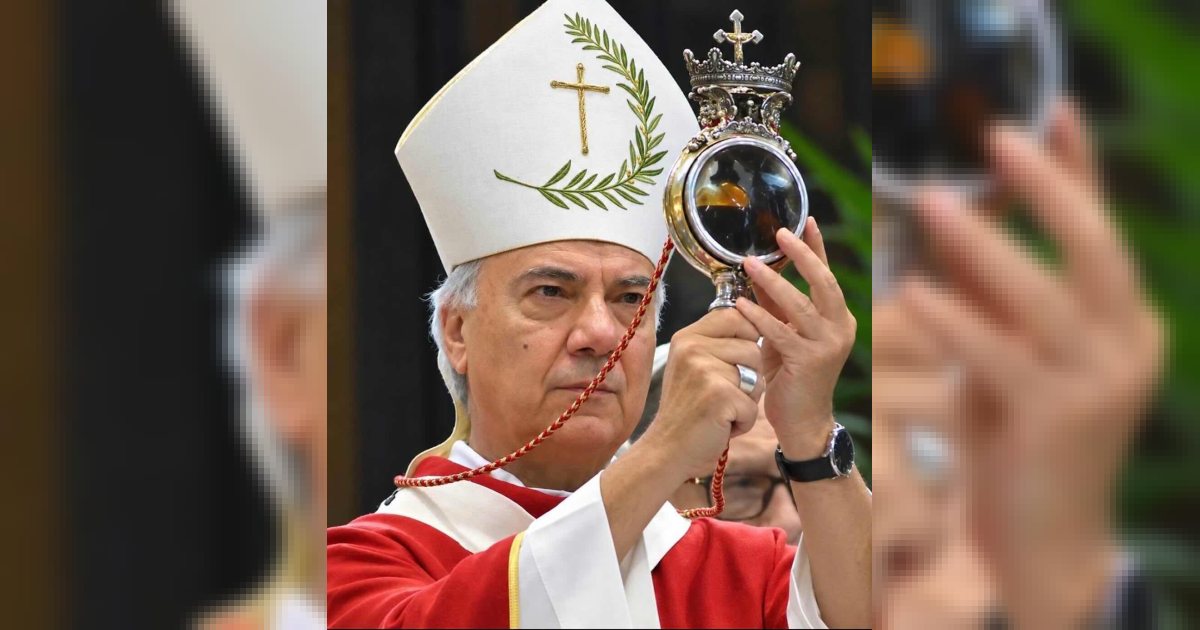
Cardinal Domenico Battaglia
Naples – Not a formal homily, not a series of ritual words dedicated to the solemnity of the feast. On the feast of San Gennaro, before the ampoule kept in the Cathedral and the city that gathers annually around its patron saint, Cardinal Domenico Battaglia chooses clear, harsh words, almost a jolt to the collective conscience.
His speech begins in Naples, from the blood that has permeated the city's recent and daily history, from the victims of crime and from the suburbs where violence continues to represent, for some young people, a model of power and social recognition.
But from Naples the archbishop's gaze quickly widens to the world, to wars, to destroyed cities, to murdered children, to mothers holding the bodies of their children in their arms.
Two different levels, but united by the same word: blood.
That of San Gennaro, kept in the ampoule and awaited by the faithful, and that of the innocent victims, which Battaglia refuses to consider a simple statistic.
"Naples, you know the blood"
It is perhaps the passage most directly addressed to the city in which the cardinal addresses the issue of the Camorra.
“Naples, you know blood,” says Battaglia, recalling the alleys where one can still hear “the sound of a gunshot,” the mothers forced to live with fear, the children who were taught too early that “a gun can inspire more respect than a book.”
It's a description of a city ravaged by organized crime that isn't limited to the victims of ambushes or murders. The cardinal also includes fearful shopkeepers, reticent families, and men and women faced with the choice between courage and survival.
Then comes the strongest sentence:
"The Camorra is war."
Battaglia defines it as a particular war, "without declaration, without uniforms, without peace treaties", but still a war because it produces a permanent condition of fear, recruitment and oppression.
"Every time a kid is recruited off the streets, we've lost a battle," he emphasizes. "Every time a child grows up thinking that easy money is the only way forward, we've lost a battle. Every time someone buys the silence of a neighborhood, we've lost a battle."
It's not just a denunciation of the criminal organization. It's a denunciation of the social terrain in which that crime can find consensus, silence, availability, and even a form of legitimacy.
"There is nothing religious about the Camorra"
And it is precisely on the relationship between crime and popular religiosity that the cardinal delivers one of the hardest blows of his homily.
The recipients, in this case, are the Camorristi directly.
“Let me say this clearly: there is nothing religious about the Camorra.”
A phrase that Battaglia immediately reinforces with an image destined to last: "It's not enough to bow before a statue, you can light a hundred candles to San Gennaro, but if you extinguish your brother's life, those candles give no light."
The message is clear: no ritual gesture, no displayed devotion, no external relationship with the cult can be transformed into a justification for violence or a badge of respectability.
Faith, in the cardinal's view, cannot be separated from concrete life and responsibility towards others.
The Camorra as a mentality
But Battaglia doesn't stop at the Camorra. The request addressed to San Gennaro is broader and concerns the city as a whole.
"Free us, not just from the Camorra, free us from the Camorra mentality."
And here the complaint shifts from crimes to everyday behavior, from what is openly criminal to that gray area where logics of favor, exchange, and oppression can assert themselves.
The cardinal speaks of "the favor asked instead of the right, of the recommendation instead of the merit, of the idea that being clever is better than being right."
This is a particularly significant part of the homily because it broadens the concept of the Camorra mentality beyond clan membership. The problem, in Battaglia's words, becomes cultural: it concerns the idea that law can be replaced by personal relationships, that shortcuts can be more worthy than rules, that personal power can prevail over collective responsibility.
And it is precisely to the little ones that the cardinal looks when he formulates his hope for next year: to be able to return before San Gennaro and thank him "because we have had the courage to truly put the little ones at the center, not of speeches, but of the choices of politics, of the community as a whole, of our city."
From the blood of Naples to the blood of the world
The homily then shifts focus. From the streets of Naples, the focus shifts to international conflicts.
Blood is still the common thread.
In front of the ampoule, Battaglia formulates a prayer that is simultaneously religious and dramatically civil:
“Gennaro, if your blood must thaw, let it thaw again, but do me this favor: when we return here next year, let the only blood we have to speak of be yours.”
The cardinal would like the blood kept in the Cathedral to be the only one evoked in the celebration. Not that of murdered children, not that of innocent victims, not that of mothers holding the bodies of their children in their arms.
“Yours and no one else’s,” he insists.
And he explains that he no longer wants to stand before the vial and have to say that the blood of San Gennaro "resembles that of murdered children."
Palestine and Ukraine: The Pain That Must Not Become a Habit
In the homily, Palestine and Ukraine are explicitly mentioned, along with other lands affected by the war.
Battaglia says he no longer wants to "name Palestine," he no longer wants to "name Ukraine," he no longer wants to add "the name of yet another wounded land, yet another destroyed city, yet another mother holding a body too small in her arms."
It's not, he specifies, a desire to forget those victims. It's exactly the opposite.
"Not because I want to forget them, but because I want there to be no need for them anymore."
The archbishop's point is the progressive normalization of horror. Contemporary man's ability to witness destruction through a screen, record the number of victims, comment on a new offensive, and then return to his daily life.
For this Battaglia says:
"I'm tired of a humanity that first produces victims and then builds monuments to mourn them."
And yet:
“I am tired of our perfect commemorations and our impossible peaces.”
"The greatest evil is getting used to war."
It is one of the most powerful passages of the entire homily.
"Perhaps the greatest evil isn't even war. The greatest evil is getting used to war."
Battaglia describes a daily life in which violence risks becoming background noise: "It's waking up in the morning, turning on a phone, watching a city burn, and still having breakfast."
Then the reflection on the count of victims.
"It's like hearing the death toll and no longer seeing the dead. Fifty. One hundred. A thousand. As if beyond a certain number, pain ceased to have a name."
The complaint concerns the transformation of death into statistics, of the individual into a number, of tragedy into a sequence of numbers.
"As if a child dying a hundred times became a statistic."
Battaglia then reverses the perspective:
"Blood is never a statistic. Blood always has a name."
And that name brings with it a mother, a home, a history, a family.
«He has someone who will continue to set an extra place that evening, at least with his eyes».
It is one of the most painful images of the homily: the place at the table that remains empty and that continues, in the memory of those who survive, to be ideally set.
«Stop»
Finally, the cardinal transforms the prayer into a direct appeal.
"In the face of Gennaro's blood, I would like a cry to come from Naples. Not a statement. Not a cautious declaration. A cry."
And the cry is just one word:
«Stop».
This isn't a generic appeal. Battaglia is addressing those who have the concrete power to fuel conflicts.
“Stop, you who hold weapons in your hands, you who give orders, you who draw borders on maps while others mark them with blood, you who think that a victory can still be called a victory when it has to be built on the body of a child.”
The next sentence expands the reasoning further: "There is no flag large enough to cover the coffin of an innocent man. There is no reason of state capable of returning a son to his mother. There is no military victory that can transform a child's blood into something just."
Battaglia acknowledges that peace "will certainly require politics," diplomacy, and law. But his homily is not a lesson in international relations: it is above all a moral plea to prevent violence from being considered inevitable.
San Gennaro and a city called to choose
In the end, the two parts of the homily – Naples and the world – coincide again.
The Camorra and war are different phenomena, with different causes and dimensions, but Battaglia approaches them through the same question: how normal can violence become before a community stops fighting back?
This is why the petition to San Gennaro isn't just about liberation from criminals. It's about a city called to free itself from a culture in which favor can replace rights, force can replace the law, easy money can become a role model for young people, and silence can be considered the price of survival.
And it concerns a world in which the risk, according to the cardinal, is even more subtle: not just waging war, but getting used to war.
On the feast of the Patron Saint, Battaglia thus delivers a homily in Naples that doesn't seek conciliatory words. He speaks of blood, fear, children, the Camorra, wars, silence, and responsibility. And before the ampoule of San Gennaro, he formulates a request that captures the full meaning of his speech: to arrive at next September 19th being able to speak only of the Saint's blood.
"Yours. No one else."
Breaking News
Jimenez responds to Gilmour's challenge, Fiorentina holds Napoli to a 1-1 draw at the Franchi.
Fiorentina and Napoli drew 1-1 at the Franchi Stadium, after a hard-fought match and… Read more
The Society of Suspicion: When Doing Good Becomes a Risk
How complicated it has become to have a civil conscience There was a time, not too long ago,… Read more
- Caserta and Province
- Naples News
- Chain drive
- Flash NEWS
- live,
- Live
- Socials
- Stories
- Breaking News
- zoom meeting
Tragedy on the Domiziana: A 22-year-old man exits his Golf to report the accident and is hit, killing him.
Yet another bloody dawn on the streets of Campania turns the end of a night into… Read more
Soul-Food Vocalists Win The Voice of Germany 2026: Four Neapolitan Voices Choose Nico Santos After the Blind Audition
Francesco and Simone Capriglione, Carmen Scognamiglio and Antonella Parmentola enchanted on the German stage with… Read more
Davide Di Lernia dies after being beheaded after crashing his motorcycle into a tram railing.
Davide Antonio Di Lernia, son of the popular host… Read more
Naples and Campania weather today, September 20: Sunday will be marked by stable weather.
Today, Sunday, September 20, 2026, begins with stable weather and… Read more

National Newspaper
Registration No. 1301 of 2016 – ROC 030531
Director: Giuseppe Del Gaudio
To contact the editorial staff click HERE |
Download our Official ANDROID APP