The Society of Suspicion: When Doing Good Becomes a Risk

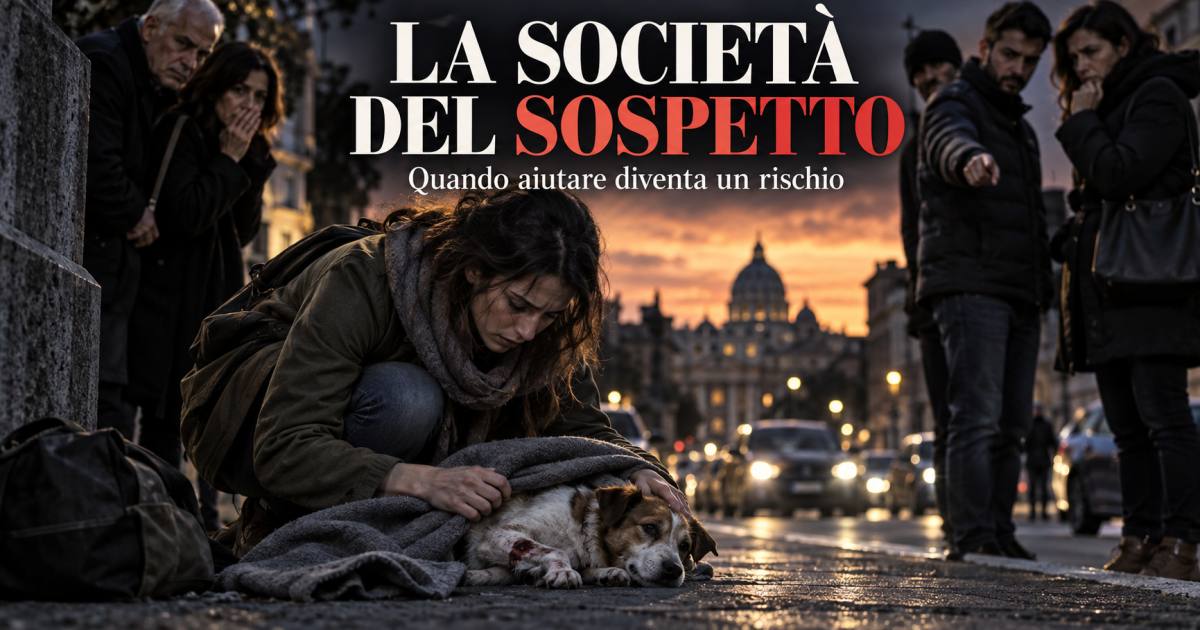
In the photo, a representative element of the story.
How complicated it has become to have a civil conscience
There was a time, not too long ago, when seeing someone in trouble almost automatically triggered an immediate reaction: stop, ask if they needed help, try to do something.
Today, however, even a seemingly simple gesture can turn into a dilemma.
Imagine finding an injured animal on the road. A dog on the side of the road, clearly in distress. A sensible person's first reaction should be to stop, secure the animal, call the appropriate person, and try to help.
Yet, more and more often, before even acting, a different thought arises: what if someone thinks I ran over them?
The society of suspicion
This is perhaps one of the most worrying aspects of the society we live in: pre-emptive suspicion.
All it takes is being in the wrong place at the wrong time for someone to construct their own interpretation of the facts.
“I saw that person near the dog.”
“He was there when it happened.”
“Maybe it has something to do with it.”
You don't necessarily need to know what happened. Sometimes a photograph, a few seconds of video, a comment posted on social media, or a report made without sufficient evidence is enough.
And so those who would simply like to provide assistance may begin to wonder whether it is better to continue.
And it's a defeat for everyone.
Because a society in which a person is afraid to stop in front of someone in difficulty is a society that risks progressively losing an important part of its civic conscience.
Even kindness is misinterpreted
The same happens in relationships between people.
Being helpful, kind, or interested in someone else's problem can be interpreted as something that necessarily hides an ulterior motive.
If you're too available, someone will wonder what you want in return.
If you help for free, someone will look for the hidden motive.
If you intervene in a difficult situation, someone may wonder why you were there.
Of course, caution is necessary. Scams exist, just as there are people who exploit the generosity of others.
But there is a huge difference between caution and permanent suspicion.
When every behavior is analyzed starting from the belief that there is necessarily something dark behind it, the risk is creating a society in which decent people simply stop exposing themselves.
When the fear of being accused becomes stronger than the desire to help
Then there is an even more delicate element.
It's extremely easy to report someone these days.
A message, a phone call, a photo posted on social media can transform a simple supposition into something that begins to circulate as if it were fact.
The problem is not, of course, reporting truly illegal behavior, which should always be possible.
The problem arises when the establishment of facts is replaced by suspicion.
“I think it was him.”
“I think it has something to do with it.”
“I saw him there.”
Being present near an event does not mean being responsible for it.
Yet the fear of being implicated, misunderstood, or accused can convince someone to choose the simplest solution: looking the other way.
The paradox of our age
The result is paradoxical.
We continually ask for greater solidarity, greater civic sense, and greater attention to others.
Then we create a social environment in which intervening can become a risk.
We demand engaged citizens, but at the same time we look with suspicion at anyone who does anything outside their own personal sphere.
Ultimately, something very simple and very dangerous can happen: people learn to mind their own business.
They see a difficult situation and move on.
Not necessarily out of selfishness.
Sometimes simply out of fear of the consequences.
When even volunteering can be misused
Then there is a second problem, perhaps even more difficult to address.
There are thousands of people who every day freely dedicate their time, money and energy to abandoned animals.
They rescue dogs and cats from the streets, pay for veterinary care, find families willing to adopt them, and continue to care for them even after they're adopted.
It is a worthy activity.
Precisely for this reason, we must prevent someone's inappropriate behavior from casting a shadow over an entire world made up mainly of volunteers who work with great sacrifice.
Over time, however, we have received more reports of people who allegedly present themselves as animal welfare volunteers but who, according to reports, use this position to put pressure on families who have adopted dogs or cats.
It's important to emphasize that these are stories and reports that must be verified on a case-by-case basis. It wouldn't be fair to automatically turn them into accusations.
But the mechanism described still deserves some reflection.
When control becomes psychological pressure
Checking that an adopted animal is well is understandable.
Indeed, in many cases it is a sign of the seriousness of the person who followed the adoption.
But there is a limit beyond which control risks turning into something else.
A dog can come back dirty from a walk.
He can roll on the ground while playing.
A cat may have messy fur.
A house with pets doesn't necessarily have to look like an advertising photograph at all times.
These are perfectly normal circumstances.
Yet, according to some of the reports received, precisely these kinds of incidents were used by self-proclaimed volunteers to claim that the animal was not being adequately cared for.
From there, requests, pressure, increasingly less optional advice would begin, and in some reported cases, even requests for money or the purchase of certain products or services.
The implication would be particularly heavy: if you don't do what we tell you, we can report you.
If such incidents were to be confirmed, they would no longer have anything to do with volunteering.
They would be a form of psychological pressure exerted by leveraging fear.
When the controller also knows where you live
There is then another aspect that makes a situation like this even more delicate.
Anyone who has followed an adoption necessarily knows a lot of information about the foster family.
He knows the name.
He knows the phone number.
And above all, he knows the address where the animal lives.
This information is perfectly normal in a serious adoption procedure, but it takes on a completely different meaning if it were used to exert an insistent and unwanted presence.
The person may therefore find themselves in the situation of knowing that the subject could reappear.
Or call again.
Or ask for new photos.
Or demand further checks.
And it is precisely here that a form of continuous pressure can arise.
The family is no longer happy with the adoption.
Instead, he begins to feel constantly under scrutiny.
The fear of a complaint
Then there is a very powerful psychological element: the fear of being reported.
Fortunately, in recent years, public awareness of animal welfare has grown, as has regulatory and social attention to animal abuse.
And it is an important achievement.
Animals must be protected and those who actually mistreat them must be held accountable.
But the very seriousness of these protections makes the potential misuse of the threat of a report or complaint particularly serious.
Because an ordinary person, even knowing they haven't mistreated their animal, can get scared.
You may think: what if he actually reports me?
Even defending yourself has a cost
The point we often forget is that being innocent does not necessarily mean avoiding all problems.
A report may need to be clarified.
A dispute may require explanations, documents, or advice.
In more complex cases, a person may decide to contact a lawyer to protect themselves.
And so spending money, wasting days, facing stress and worries simply to demonstrate something that perhaps, in reality, he had never done.
It is precisely this possibility that makes pressure such as: “if you don’t do what I tell you, I’ll report you” particularly burdensome.
Not because a report automatically equates to a conviction.
Absolutely not.
But the very thought of having to face legal proceedings, provide explanations, or incur expenses to defend oneself can become a powerful psychological tool for someone who isn't fully aware of their rights.
Control cannot become blackmail
We must then establish a very simple principle.
It is one thing to intervene when there are concrete elements that suggest abuse.
Another is to use any imperfection as an excuse.
A dirty dog after playing does not automatically mean the dog has been abused.
An animal that appears disheveled, muddy, or tired for a few hours does not automatically mean that the animal is neglected.
A choice other than the one suggested by a volunteer does not automatically mean bad custody.
And above all, the animal's well-being cannot become a justification for demanding money, purchases, favors, or behaviors that have nothing to do with the animal's real needs.
Serious protection also protects adopters
Protecting animals also means preventing their protection from being misused.
Because every abuse first and foremost harms those who work seriously.
If a family has a negative experience after an adoption, they may decide not to adopt again next time.
If you hear reports of obsessive checking or pressure, you may want to seek help elsewhere.
And in the end, the ones who will pay the price will be the animals waiting for a family.
Protection should therefore work both ways.
Protect the animal from anyone who might mistreat it.
But also protect the adopter from those who might use their role inappropriately.
It is precisely these behaviors that destroy trust.
And here we come to the crux of the matter.
It only takes a few people in bad faith to harm thousands of people in good faith.
If someone uses solidarity to gain advantages, next time we will be more wary of those who sincerely ask for help.
If someone uses volunteering as a tool of pressure, we will also begin to look askance at those who volunteer for free.
If someone makes accusations too lightly, those who could intervene in a difficult situation may decide not to do so.
And this is how the most important capital of a community is slowly destroyed: trust.
Trust is a collective wealth
A society also functions through thousands of small behaviors that no law can impose.
Stopping in front of an accident.
Helping an elderly person.
Report an injured animal.
Return a wallet found on the street.
Notify someone that they have forgotten something.
Give a few minutes of your time to a stranger.
They are seemingly insignificant gestures, but they constitute the invisible fabric that holds a community together.
But when every gesture is accompanied by the question “what will they think of me?”, something begins to break.
We need to go back to distinguishing facts from suppositions
We probably need to revisit a very simple rule: facts come first, judgments come later.
Seeing someone next to an injured animal does not mean that they were the one who injured it.
Seeing someone help someone doesn't necessarily mean they have an ulterior motive.
Likewise, declaring oneself a volunteer or benefactor does not automatically make every behavior correct.
Civic awareness requires both: trust and critical thinking.
Trust without being naive.
Check without turning into inquisitors.
Report when there is concrete evidence, without destroying someone's reputation based on an assumption.
Help without fear of being misunderstood.
Because the day no one stops will be too late
The worst consequence of a society of suspicion is not arguments on social media.
It's indifference.
It's the moment when someone sees a wounded dog and decides to move on.
He sees a fallen person and thinks it's probably best not to approach.
He witnesses a difficult situation and decides that getting involved is too risky.
That day we will perhaps have a very cautious society.
But we will certainly have a lonelier society.
For this reason, we must defend those who act in good faith and, at the same time, isolate those who use solidarity, volunteering, and good causes for personal gain.
Because having a civic conscience shouldn't become an act of courage.
It should just go back to normal.
Breaking News
- Caserta and Province
- Naples News
- Chain drive
- Flash NEWS
- live,
- Live
- Socials
- Stories
- Breaking News
- zoom meeting
Tragedy on the Domiziana: A 22-year-old man exits his Golf to report the accident and is hit, killing him.
Yet another bloody dawn on the streets of Campania turns the end of a night into… Read more
Soul-Food Vocalists Win The Voice of Germany 2026: Four Neapolitan Voices Choose Nico Santos After the Blind Audition
Francesco and Simone Capriglione, Carmen Scognamiglio and Antonella Parmentola enchanted on the German stage with… Read more
Davide Di Lernia dies after being beheaded after crashing his motorcycle into a tram railing.
Davide Antonio Di Lernia, son of the popular host… Read more
Naples and Campania weather today, September 20: Sunday will be marked by stable weather.
Today, Sunday, September 20, 2026, begins with stable weather and… Read more
Naples, nighttime checks in Posillipo: traffic, illegal parking, and illegal parking attendants are being cracked down on.
Naples - Nighttime checks in Posillipo, where weekend nightlife once again intersects... Read more
- Caserta and Province
- Naples News
- Chain drive
- Flash NEWS
- live,
- Live
- Socials
- Stories
- Breaking News
- zoom meeting
Massive four-car collision on the Domiziana Highway leaves one dead and road closed to Rome.
It was a bloody Sunday on the Campania road network. A very serious traffic accident occurred in… Read more

National Newspaper
Registration No. 1301 of 2016 – ROC 030531
Director: Giuseppe Del Gaudio
To contact the editorial staff click HERE |
Download our Official ANDROID APP