Paestum and the Sele Plain: the Campanian landscape told by the sweet Migliaccio
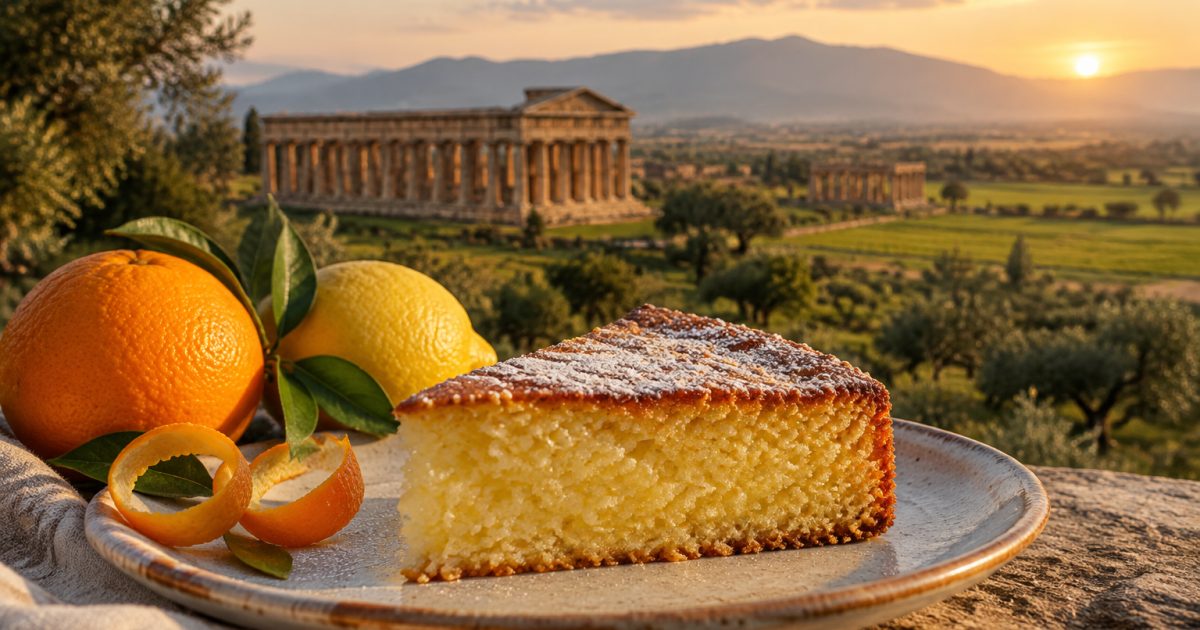
Between the temples of Paestum and the fields of the Piana del Sele, the sweet migliaccio brings to the table the soft consistency and aromas of Campania cuisine.
Between the temples of Paestum and the fields of the Piana del Sele, the sweet migliaccio brings to the table the soft consistency and aromas of Campania cuisine.
In Paestum, the landscape is broad and clearly visible: Doric columns emerge from the plain, while further away stretch crops, canals, rural roads, and the outline of the Cilento hills. It is a land where history is inseparable from daily life. The monuments of the ancient city coexist with a still recognizable agriculture, consisting of pastures, vegetable gardens, orchards, and livestock farms that have given the Sele Plain its identity.
In this scenario, food doesn't need special effects. What matters is the quality of the raw materials and how they're processed. Milk, ricotta, citrus fruits, and wheat evoke a Campanian home cooking capable of creating desserts with simple yet precise structures. Sweet migliaccio belongs to this family: a soft, fragrant treat, suitable for the Carnival table but also a staple in regional culinary memory.
Its name recalls millet, an ingredient used in ancient recipes and later replaced, in today's most popular recipe, by durum wheat semolina. The result is a low, creamy cake with a lightly golden surface and a firm, yet not dry, interior. The citrus aroma emerges without overpowering the flavor of the milk and ricotta; the sweetness remains subdued when the dough is carefully baked.
The Sele Plain between history and countryside
Visiting Paestum means crossing a land where archaeology and agriculture almost blend together. The archaeological area preserves the temples of Hera, Neptune, and Athena, as well as traces of the ancient city and the museum documenting its history. All around, the plain accompanies the route with a succession of fields and rows of vines, while the Sele River flows toward the Tyrrhenian Sea and the coastline opens up south of the city.
The relationship with cuisine also stems from this availability of products. The Piana is known for its dairy industry and horticultural crops; the countryside also features citrus and fruit trees that are used in preserves and homemade desserts. Migliaccio is not a recipe exclusively tied to Paestum, but can become a coherent interpretation of the region: it brings together ingredients common to the Campania tradition and presents them in a form suitable for sharing.
To enjoy it with greater awareness, the best time is after visiting the temples, when the light changes on the stones and the plain takes on warmer hues. There's no need to look for a staged setting: a slice, a fork, and the time needed to distinguish the citrus notes from the creaminess of the dough are enough.
How to prepare a soft migliaccio
For a 22-24 cm cake pan, you'll need 500 milliliters of milk, 125 grams of semolina, 250 grams of ricotta, 180 grams of sugar, four eggs, 40 grams of butter, the grated zest of one unwaxed orange and half a lemon, a pinch of salt, and, if desired, a little vanilla. For the frosting, simply add powdered sugar and a knob of butter for the pan.
- Pour the milk into a saucepan with the butter, salt, and citrus zest. Heat over low heat, without boiling.
- Remove the peels, then slowly add the semolina, whisking to avoid lumps. Cook for a few minutes until the mixture becomes a thick cream.
- Transfer the mixture to a bowl and let it cool. This step is important: if the base is too hot, the eggs risk curdling when added.
- Mix the ricotta with the sugar until smooth. Add the eggs one at a time, then fold in the semolina cream and vanilla, if using.
- Butter the cake pan and pour in the batter. Bake in a preheated oven at 180°C (350°F) for about 45-50 minutes, checking that the top is golden brown and the center is still slightly soft.
The migliaccio should be allowed to cool completely before unmolding. When it comes out of the oven, it may seem too soft, but the texture will firm up as it rests. After a few hours in the refrigerator, it becomes easier to cut and acquires a firm consistency. Before serving, it's best to let it sit at room temperature for at least twenty minutes, so the citrus flavors come out more clearly.
The ricotta must be well drained, otherwise the mixture will be too moist. The semolina should also be added slowly: rushing the cooking or inconsistent stirring will compromise the final creaminess. Those who prefer a more pronounced flavor can add a small amount of aromatic liqueur, but it's not essential. The most balanced version relies on the fresh zest and the quality of the dairy products for its character.
A slice between temples and fields
Sweet migliaccio is a perfect accompaniment to a tour of the Sele Plain because it shares the same tone as many regional dishes: it's not ostentatious, but requires care. Its golden surface recalls the light on the stones of Paestum; the pale, soft interior suggests the presence of milk and ricotta, ingredients that are part of the plain's agricultural culture.
At the end of the day, the landscape once again becomes the focal point. The temples remain immobile, the fields change color with the sun, and the outline of Cilento fills the horizon. A slice of migliaccio, served without excessive decoration, conveys precisely this measure: that of a Campanian dessert born of patience, capable of connecting domestic memories to the land that surrounds it.
Breaking News
Growing local tourism: ASMEL 2026 inaugurates two profiles for the promotion and management of events in municipalities.
Summer data points to a strong tourist season, even outside of major destinations. ASMEL… Read more
Annarita Borelli, cinema beyond the set: from Pompeii to Vanzina, a story of memory and future
From the presidency of the Pompeii International Film Festival to Enrico Vanzina's set: for… Read more
Endoscopic ear surgery at San Paolo: a live international workshop strengthens training and innovation.
The 8th and 18th International Workshop on Endoscopic Ear Surgery concluded at San Paolo Hospital in Naples… Read more
Giulio Regeni, half-justice: three Egyptian 007s sentenced to 10 years in prison, one acquitted
The trial held before the Court of Cassation ended with a historic, albeit partial, ruling… Read more
Morandi in Naples to celebrate the 60th anniversary of 'There Was a Boy'
Gianni Morandi arrives in Naples for the penultimate leg of the summer leg C'ERA UN RAGAZZO… Read more
Garlasco murder: Parma RIS investigators knew Stasi was innocent; evidence was not included in the trial.
Pavia - Alberto Stasi could have been exonerated 19 years ago: the Parma RIS... Read more

National Newspaper
Registration No. 1301 of 2016 – ROC 030531
Director: Giuseppe Del Gaudio
To contact the editorial staff click HERE |
Download our Official ANDROID APP
