School's back, six expert tips for choosing the right calculator: the Skuola.net guide

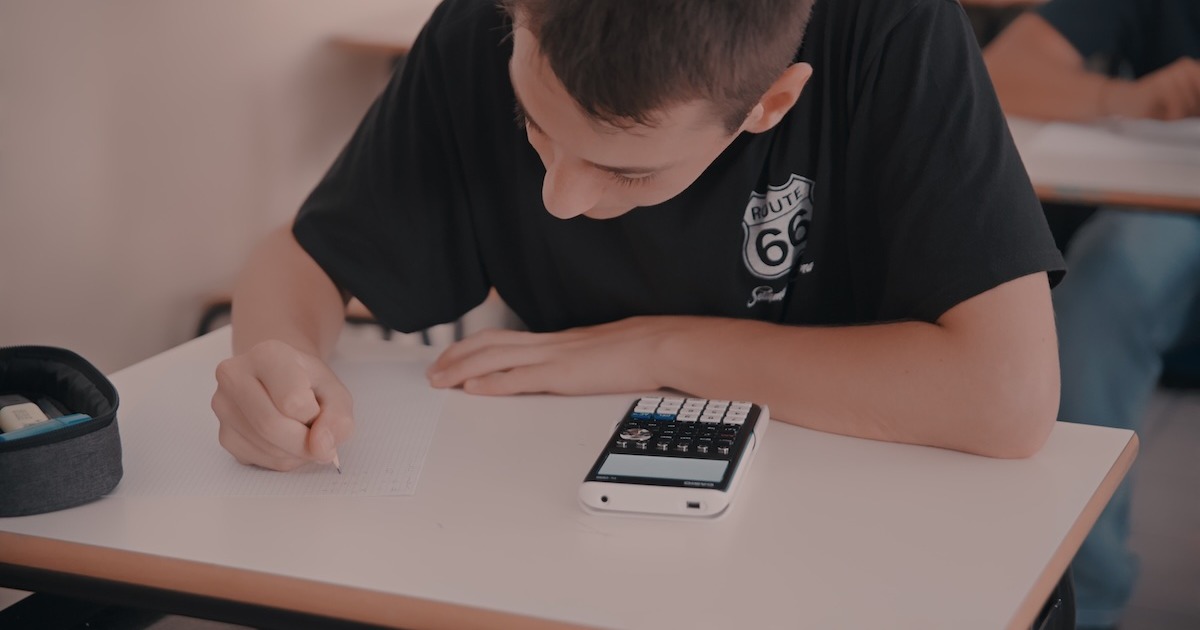
In the photo, a representative element of the story.
It often ends up in the cart by accident, without much thought, while checking off the back-to-school shopping list, yet it's a fundamental tool for getting out of trouble with the most difficult subject of all: the calculator and math, respectively.
Massimo Esposito , an expert in teaching this technical discipline par excellence, knows this well , but above all he was the “father” of the written exam questions for the scientific high school diploma for years in his role as technical director of the Ministry of Education.
The main problem, according to him, lies not in the cost – a model suitable for most school curricula costs around twenty euros – but rather in the lack of information on what is needed and when.
For this reason, the specialized portal Skuola.net interviewed Esposito to outline the definitive guide to buying a calculator , for students but above all for families.
- Basic? Not even in primary school.
By the end of elementary school, children begin to explore more nuanced arithmetic concepts: calculating fractions, using parentheses, and percentages.
Therefore, choosing a tool that is too limited – to just four operations and little more – would mean making the student's work harder , and he would inevitably find himself having to replace it after a very short time.
- The smartphone is not a calculator
Equally illusory is the belief that you can save money by downloading free apps onto your smartphone : on the one hand, because cell phones can no longer be used at school due to the well-known bans, and on the other, because everything around those icons creates inevitable distractions.
The “physical” calculator, on the other hand, is a tool entirely dedicated to study, capable of introducing the student to a real “mathematical environment” that promotes concentration.
- The golden rule: take it only with the “natural display”
Regardless of the brand and model, there is one essential feature to consider when choosing a calculator: the natural display , which allows you to view fractions, roots, powers and expressions on the device's screen in the exact graphical form used in textbooks.
It's a simple detail, but it radically changes the study experience: it makes reading and writing numbers and expressions much easier, helps avoid trivial interpretation errors, and allows you to focus all your cognitive attention on mathematical reasoning.
On the contrary, without the natural display, writing an expression correctly takes much longer and forces the use of parentheses that is often cumbersome, unnatural and misleading.
- An investment that accompanies you over the years: from science to graphics
As the school years progress, mathematics changes: in addition to numbers, books also feature "objects"—such as functions—that, in addition to having to be calculated, can also be "observed."
For this reason, if a scientific calculator is strongly recommended from the end of primary school to middle school , in the delicate transition between the end of middle school and the first two years of high school , it becomes very useful to equip oneself with a graphic calculator.
This tool, in fact, does not limit itself to saying "how much" an operation does, but visually shows "what happens if", helping you to reason, to explore the behaviors of the functions and to independently verify whether you are following the right path.
- It's best to buy it in advance and what to check (be careful about the final exam)
The calculator is, in effect, a traveling companion, and therefore you have to learn to "know" it: it is therefore better to buy it at the beginning of the school year , to have time to play with it a bit, perhaps together with some classmates or with the tutorials found online.
When choosing, you can ask your teacher for advice. However, in high school, it's essential to follow the official list updated annually by the Ministry of Education of the models admitted to the final exam.
- Ok, what's the right price?
When purchasing, the price difference between a scientific and a graphical model – around 80 euros more – can be significant for families.
However, it should be considered that the investment is spread over 4 or 5 years of secondary school and pays for itself down to the last cent , especially in areas such as scientific high schools or technical institutes.
The scientific calculator sits there awaiting instructions, while the graphics guide the student through the problem-solving process, helping them understand in advance what the useful calculation is, and then, of course, performing it as well: this shouldn't be underestimated!
In any case, whatever your budget, never give up on a natural display.
Breaking News
Naples: 31-year-old man arrested for assaulting police officers during a checkpoint.
Tense moments occurred yesterday afternoon in Piazza Giuseppe Di Vittorio, Naples, where… Read more
Revolut scam: Hackers use institutional email to steal customer data: Police investigate
Revolut scam using a 'government email' to steal customer data:… Read more
Agnano Hippodrome: concession signed: €16,8 million for redevelopment
The Agnano Hippodrome enters a new phase. The City of Naples has completed the… Read more
San Paolo, first surgery with the Da Vinci Robot: robotic surgery debuts in urology.
Robotic surgery debuts at San Paolo Hospital in Naples. In the Urology Unit,… Read more
Coroglio: Roadside checks and awareness campaigns against drunk driving in nightlife venues.
The State Police continues to prevent road accidents and raise awareness of the risks… Read more
Agerola fire: Deputy Mayor: "The community is at risk."
Hours of fear in Agerola, where a vast fire has affected the area, reaching… Read more

National Newspaper
Registration No. 1301 of 2016 – ROC 030531
Director: Giuseppe Del Gaudio
To contact the editorial staff click HERE |
Download our Official ANDROID APP