Paestum and the Sele Plain: buffalo mozzarella, tomatoes, and basil among temples and countryside.
At the foot of the temples of Paestum, buffalo mozzarella meets tomato and basil in a simple dish, tied to the Salerno plain and its agricultural rhythms.

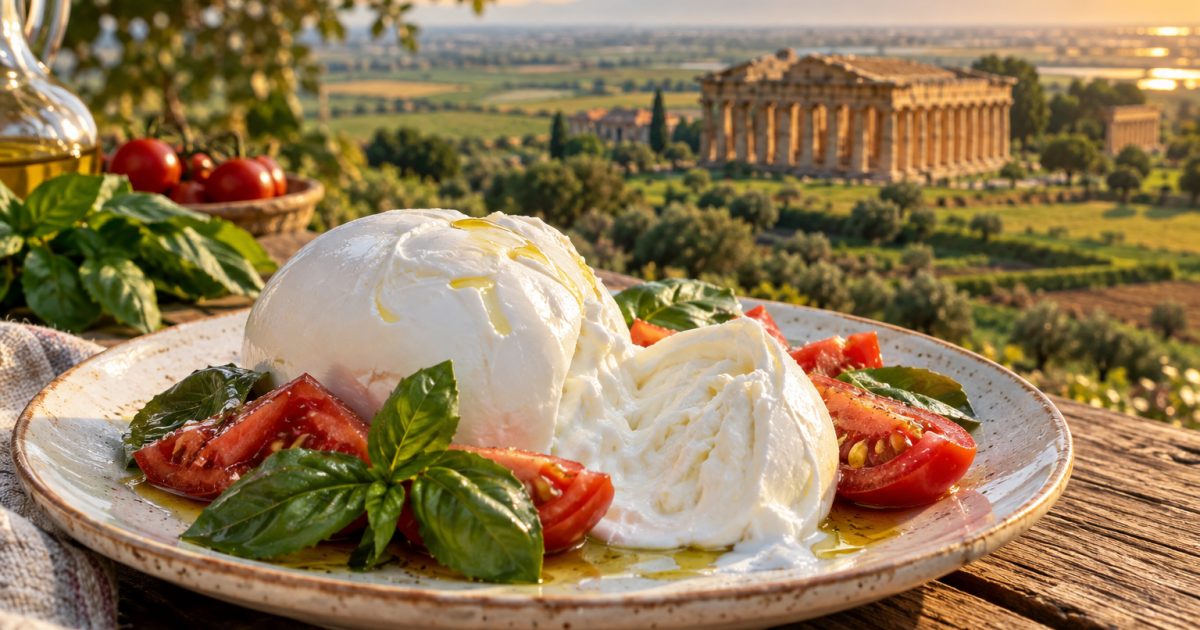
In Paestum, among the Doric temples and the countryside of the Sele plain, buffalo mozzarella, tomato, and basil make up a simple dish rooted in the Campanian landscape.
The plain between temples and buffalo farms
The skyline of Paestum is recognizable from afar: Doric columns, pale stone, meadows and rows of trees that change color with the seasons. The archaeological site, in the Capaccio-Paestum area, opens onto a fertile plain, marked by the presence of the Sele River and a long history of agriculture.
Here, the landscape is more than just a backdrop to the table. In the Sele Plain, buffalo farming and milk processing have long been an important part of the local gastronomic identity. This is one of the main production areas of Campania's DOP buffalo mozzarella, with dairies and farms scattered across the Salerno plain.
The connection to the dish is therefore tangible, even if mozzarella, tomato, and basil aren't part of a historic recipe codified exclusively in Paestum. Rather, it's a natural blend of Mediterranean ingredients and seasonal availability: freshly processed buffalo milk, ripe tomatoes grown in the Campania countryside, fragrant basil, and extra virgin olive oil.
Tasted after a visit to the temples, this dish immediately evokes a sense of the region. The mozzarella lends a supple and juicy texture; the tomato adds acidity and sweetness; the basil introduces a green, almost balsamic note. The result is delicate yet not devoid of character, especially when the ingredients are treated without unnecessary coatings.
The dish: few ingredients, precise times
For four people, simple, fresh ingredients are enough:
- 600 grams of buffalo mozzarella DOP;
- 500 grams of ripe, firm tomatoes;
- a small bunch of fresh basil;
- extra virgin olive oil;
- salt to taste.
Choosing the mozzarella is the key step. It should be kept in its liquid until serving. If it has been stored in the refrigerator, it's best to let it gradually return to room temperature, without immersing it in hot water or subjecting it to sudden changes in temperature. This way, the cheese retains a softer texture and the milkiness remains clearly visible when cut.
Tomatoes should be ripe, fragrant, and not excessively watery. Wash, dry, and cut into wedges or slices, depending on their consistency. If they release a lot of liquid, you can let them drain for a few minutes, but avoid salting them too early: salt tends to cause the sauce to lose water and make it too dilute.
The arrangement can follow two approaches. The whole mozzarella, placed in the center of the plate and surrounded by tomatoes, enhances the shape and invites you to cut it on the spot. Alternatively, it can be torn by hand or divided into bite-sized pieces, to better distribute its juices over the tomatoes. A knife is useful, but don't crush the mozzarella: the mozzarella should open up, not fall apart.
The basil is added last, either whole or delicately torn with your fingers. The oil should be drizzled in, without submerging the ingredients, while the salt should be adjusted according to the mozzarella's natural saltiness. Balsamic vinegar, elaborate sauces, or intense spices are not necessary: they would alter the balance between the milk, tomato pulp, and the herbaceous aroma of the basil.
How to bring Paestum to your plate
The simplicity of the preparation allows you to also focus on the quality of the service. A large, light-colored ceramic plate highlights the white mozzarella, the red tomatoes, and the green leaves. The sauce should be added just before eating, so that the mozzarella doesn't lose its texture and the tomatoes retain some of their structure.
It's a dish suited to the warm season, but its connection to the Sele Plain isn't limited to summer. Mozzarella is produced year-round; tomatoes and basil, however, express their best characteristics in the brighter months. In spring and summer, the basil is at its most intense and the tomatoes reach full ripeness, while in other seasons, it's important to pay more attention to the origin and degree of ripeness.
Bread can accompany the dish, especially if it has a firm crust and a crumb capable of absorbing the mozzarella's liquid and tomato juice. Here too, size is important: the accompaniment should support the dish, not dominate it.
From the table to the landscape of Paestum
The Sele Plain can also be understood through its contrasts: the severe geometry of the temples, the open expanse of the fields, the rural roads, the crops, and the discreet presence of buffalo herds. The archaeological and agricultural landscapes are not separated by a clear line; they coexist on the same plain and tell the story of different eras.
Serving buffalo mozzarella, tomato, and basil in this context means acknowledging the value of a cuisine that doesn't need to be complicated to be expressive. The freshness of the milk, the ripeness of the tomatoes, and the aroma of the basil convey a Campanian plain, solid and luminous.
After visiting the archaeological site, the dish ideally guides the gaze toward the countryside and the distant mountain profile. It's not a gastronomic decoration of the monument, but an edible synthesis of the region: a few ingredients, crafted with respect, capable of bringing the agricultural character of the Sele Plain to the table.
Breaking News
Santa Maria Capua Vetere: The ANM challenges the reasons for the transfer of prosecutor Imparato.
The ANM responds to Annalisa Imparato's statements about pressure and transfer, defining the climate in the office… Read more
Naples, doctors on the run: voluntary resignations outnumber retirements.
Naples - It's no longer just age, it's no longer just retirement that's emptying... Read more
Naples, "Her husband risks arrest": A fake soldier burglarizes an elderly woman in Posillipo, and a 24-year-old is arrested.
Naples - A cautious attitude while leaving a residential building in Posillipo raised suspicions among… Read more
Naples: San Pietro a Majella Conservatory announces a competition for three AFAM018 piano teachers (full-time, permanent).
Public competition at the Naples Conservatory for three full-time AFAM018 piano teachers… Read more
Capua: Direct connection to electricity grid: café owner reported
The Carabinieri of Capua, with the technical support of Enel Distribuzione, discovered a connection… Read more
America's Cup in Naples: booming visitor numbers and record-breaking prospects for 2027
Naples records staggering numbers in the America's Cup preliminary regatta: over 250 visitors, a… Read more

National Newspaper
Registration No. 1301 of 2016 – ROC 030531
Director: Giuseppe Del Gaudio
To contact the editorial staff click HERE |
Download our Official ANDROID APP
