Fake CUP, suspicious text messages on cell phones: "Urgent communications." Be careful which numbers to call back.
In the image, a context connected to the facts.
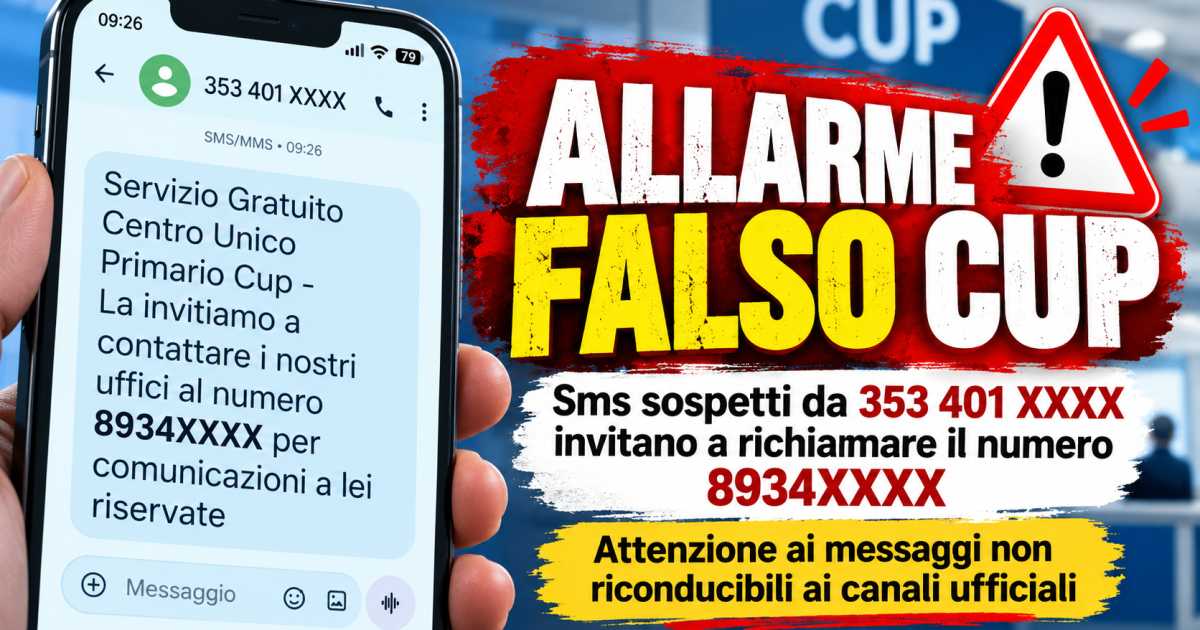
Several readers have reported messages inviting them to contact supposedly Central Reservations offices. Initial checks raise doubts about the authenticity of the communications: the numbers do not appear to be traced back to official health service channels.
For several days now, several readers of our newspaper have been reporting receiving suspicious text messages, apparently sent from the CUP, the Single Healthcare Booking Center.
The messages refer to supposedly urgent communications and invite the recipient to contact a telephone number indicated in the text. This wording could easily mislead, especially those waiting for a medical appointment, a diagnostic test, or information regarding a healthcare appointment.
What makes the communication suspicious is above all the origin of the message: the reported SMS messages appear to be sent from mobile phone numbers, while the contact number to be called does not appear to have any connection with the official CUP channels.
Checking telephone numbers
Initial checks carried out on the numbers reported by readers reveal elements that call for maximum caution.
Neither the number used to send the message nor the one reported in the text message appear, at the moment of the checks, to be traceable to the institutional contact details of the Single Booking Center.
A further concern arises when consulting some online services dedicated to identifying unknown telephone numbers. In some cases, the information published by users appears to link certain numbers to commercial or advertising communications, including those related to the energy market.
Of course, this information doesn't allow us to definitively identify the person responsible for the text messages, nor to determine the actual destination of the calls. However, this information contributes to raising doubts about the authenticity of the communications received.
The false sense of urgency
The mechanism used is particularly insidious because it exploits the reference to a health service known to millions of citizens.
Anyone who receives a message that talks about urgent communications from the CUP might think it is a changed appointment, a test to be confirmed or an administrative issue relating to their health.
It is precisely this sense of urgency that represents one of the main alarm bells.
The communication does not necessarily provide accurate information about the alleged healthcare practice, but it encourages the recipient to make a phone call to find out more.
The risk is that of coming into contact with individuals outside the healthcare system, receiving further commercial solicitations, or, in the most serious cases, being involved in fraudulent schemes.
Fake CUP SMS messages, cases already reported in Italy
The phenomenon is not isolated. Throughout 2026, several health authorities and regional administrations published warnings regarding fake CUP messages.
The Liguria Region, for example, reported text messages last January asking people to call back premium rate numbers for alleged personal communications. The Lombardy Region and several health authorities have also reported similar attempts.

More recently, on August 28, 2026, the Piacenza Local Health Authority reported messages that even used a reference to a supposed toll-free number, urging citizens not to contact the indicated number.
In some documented cases, the scam involves tricking the victim into calling premium rate numbers, with the risk of high charges. However, it's impossible to confirm that this is also the mechanism behind the SMS messages received by our readers, given the lack of further technical information on the numbers involved.
How to recognize a suspicious message
The advice is not to automatically trust a communication just because it contains the acronym CUP or refers to a supposed health office.
Before making any phone call, it is advisable to carefully check both the sender's number and any number included in the message.
An unknown mobile number, a generic text message about an emergency without providing details, and a request to call back from an unverifiable number are all signs that should prompt caution.
It should also be remembered that the number displayed as the sender, in itself, is not always a guarantee of authenticity, since there are techniques that allow the originating identifier to be falsified.
What to do if you receive a fake CUP SMS
The recommendation is simple: do not call back the number indicated in the message until you have verified its authenticity.
If you have scheduled medical appointments, it's best to contact your local health authority (ASL) or CUP directly using the contact information published on their institutional websites.
Official numbers are easily found online through the portals of the health authorities and regions. It's important to search for them independently, avoiding using the contact information provided in the suspicious message.
Furthermore, you should not share personal data, codes received via SMS, banking information, or health details with anyone whose identity has not been verified.
In the event of possible fraud attempts, messages can be reported to the Postal Police, keeping a screenshot with the text and the sender's number.
A reminder to readers: always check communications.
The reports we've received confirm the importance of staying alert to messages that use the names of public agencies and services to solicit telephone contact.
Currently, there is insufficient evidence to determine who actually sent the reported text messages, nor the exact purpose of the communications. What emerges is a potentially misleading presentation, which could lead recipients to believe they were contacted by an official health service.
The CUP has verifiable institutional channels and any questionable communications must be checked directly through them.
Our invitation is therefore to be wary of text messages requesting urgent contact to unknown numbers, not to be influenced by the presumed urgency and to pay particular attention to elderly people or those less accustomed to recognising these scam attempts.
A simple check can avoid unwanted calls, potential charges, and risks to your data privacy.
Sources of feedback: institutional notices from the Liguria Region, the Lombardy Region, the Piacenza Local Health Authority, and the Central Tuscany Local Health Authority. Specific reports from readers and the results of numbering checks are reported based on information provided to the editorial staff; they do not constitute definitive confirmation of the senders' identities.
Breaking News
Salerno, the Alessandro Farina case: "The Supreme Court rules in our favor, but Ruggi won't pay compensation."
The Supreme Court of Cassation has definitively ruled on the responsibilities for Alessandro Farina's death, but the… Read more
Fonderie Pisano, the CGIL (Italian General Confederation of Labour): "Layoffs confirmed starting November 1st, answers needed."
Layoffs starting November 1st and an appeal to the Regional Administrative Court (TAR) against the Campania Region. This is what, according to... Read more
Orta di Atella, torchlight procession for Salvatore Calignano: the worker died after an eight-meter fall.
A torchlight procession to remember Salvatore Calignano and bring the issue of safety back to the forefront of the public eye… Read more
The "Camellia Garden" opens at the Royal Palace of Caserta, offering employment and independence to 10 women victims of violence.
A place that symbolizes beauty also becomes a space for redemption and autonomy. At the Royal Palace... Read more
Undeclared work and safety violations: Commercial activity suspended in Grumo Nevano
Grumo Nevano - State Police conducts a wide-ranging raid to prevent... Read more
ASMEL 2026 competition, final hours to apply: hiring in municipalities, applications by tomorrow at 12:00 PM
Last hours to participate in the ASMEL 2026 Maxi Notice, the national selection that opens the… Read more

National Newspaper
Registration No. 1301 of 2016 – ROC 030531
Director: Giuseppe Del Gaudio
To contact the editorial staff click HERE |
Download our Official ANDROID APP
