'Golden Hands', the labor factory: a thousand workers, 155 paper companies, and 37 million seized.

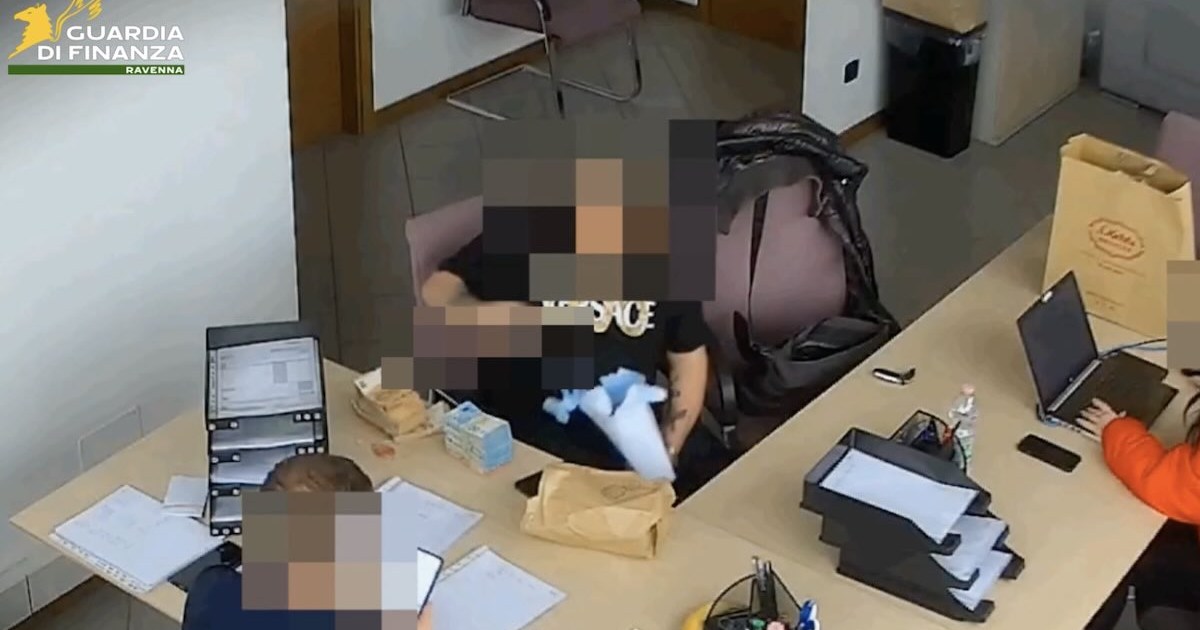
The factory of labor: a thousand workers, 155 paper companies and 37 million seized
A thousand workers within a system built on "reservoir" companies
The investigation, conducted by the Economic and Financial Police Unit of the Ravenna Guardia di Finanza and coordinated by the local Public Prosecutor's Office, begins in the labor market and extends to international money laundering networks. At the center of the operation, dubbed "Golden Hands," is an alleged scheme for the illicit supply of labor and the movement of large sums of money.
Finance police have executed an emergency precautionary seizure of approximately €37 million, identified as profits that, according to the investigation, would have been derived from tax crimes and subsequent money laundering activities. The focus is on cash, movable assets, and real estate attributable to the suspects.
At the same time, over 40 searches were carried out in nine provinces: Ravenna, Rimini, Cesena, Naples, Caserta, Bergamo, Padua, Taranto, and Lecce.
The investigation would have allowed the reconstruction of a structure in which numerous companies, at least formally operating in the mechanical construction sector, would have in reality been used simply as containers for workforce.
The pool identified by investigators is impressive: around a thousand workers, mostly welders, carpenters, and workshop laborers, largely of foreign origin.
Hiring and firing would have been modulated on the basis of the actual needs of the companies which had the means, structures and organisation necessary to carry out orders and subcontracts.
The advantage for businesses: lower costs and always available manpower
According to the investigative reconstruction, the mechanism would have allowed the companies actually operating to obtain a double advantage.
On the one hand, tax savings, on the other, the possibility of continuously using manpower without having to deal with the entire administrative and contributory burden associated with a normal employment relationship.
The system envisioned by the Prosecutor's Office would have left some of the obligations inherent in the employment relationship marginalized, from wage and social security protections to worker stabilization, while also avoiding the need for authorized temporary employment agencies.
But it is by following the financial flows that the investigation would have brought to light a second, even more complex level of the organization.
The network of 155 paper companies
The money collected for the supply of manpower was not entirely used to pay the workers.
Investigators followed the so-called "money trails," identifying additional individuals who, according to the prosecution, were responsible for laundering the funds.
The financial heart of the system was apparently located mainly between Naples and Bergamo, through a network of 155 shell companies.
The companies allegedly issued invoices for non-existent transactions totaling approximately €130 million. The sums were then transferred through various bank accounts before being refunded in cash, with a commission of between 14 and 22 percent.
This is the scheme that investigators trace back to so-called "underground banking," a parallel money movement system that allows large sums to be transferred outside of normal financial circuits.
Over the course of approximately two years, according to the Guardia di Finanza, approximately 1.200 additional economic entities were implicated, while more than 80 million euros were transferred abroad.
Eleven million tax credits deemed fictitious
The system would also have had a further element on the tax front.
The paper companies, although able to generate taxable income on an accounting basis, would have had no real interest in paying the accrued taxes, because these would have been systematically offset through approximately 11 million euros in tax credits deemed fictitious.
This is one of the aspects that further broadens the scope of the investigation: not only labor and invoices for non-existent transactions, but also a mechanism intended, according to the prosecution's hypothesis, to neutralize the tax effects of the transactions through non-existent credits.
The financial office and the hidden cash
The searches apparently led to the discovery of what investigators consider to be a real “financial office”.
Inside, they found servers, computers, a banknote counting machine, more than a hundred smartphones, and hundreds of credit cards that, according to investigators, could be used to withdraw money.
And then the cash: around 250 thousand euros, along with jewels and numerous luxury watches.
Among these, a specimen with an estimated value of around 100 thousand euros.
During the investigation, properties, automobiles, and hundreds of bank accounts were also identified. The total value of the financial assets inspected will be determined in the coming days.
Money in San Marino and the version of gambling winnings
A specific chapter of the investigation concerns collaboration with the Single Court of the Republic of San Marino.
Thanks to judicial cooperation, the seizure of approximately 7,5 million euros relating to financial transactions attributable to one of the suspects, who had previously been convicted of tax crimes, was ordered.
According to investigators' reconstruction, the man allegedly justified the availability of certain financial resources by claiming they came from gambling winnings.
The information provided by the Italian judicial authorities prompted the Sammarinese authorities to initiate their own investigations, including into the operation of some slot machines and the conduct of some employees.
An investigation that spans nine provinces
The geography of the operation reflects the national dimension of the alleged system.
From Romagna, where the investigation began, the investigation extended to Lombardy, Campania, Veneto, and Puglia. Naples and Caserta represent key areas of investigation, particularly due to the network of companies used, according to the prosecution, in the financial transactions.
According to investigators, the amount of money involved, the number of companies involved, and the number of workers involved outline a system capable of intertwining tax evasion, labor exploitation, and money laundering.
The crackdown on assets
The aim of the operation was not only to reconstruct the individual crimes, but also to directly attack the assets believed to be linked to illicit profits.
Hence the emergency seizure of up to €37 million, a measure aimed at preventing the dispersion of the financial resources and assets identified during the investigation.
The Guardia di Finanza emphasizes in this regard how the fight against tax fraud is intertwined with that of the illicit supply of labor and the subsequent reinvestment of the proceeds in the legal economy.
This perspective affects not only the financial damage, but also competition between businesses: those who, according to the investigation, use irregular labor channels may incur different costs compared to operators who fully comply with tax, social security, and labor obligations.
Twenty-two people under investigation
The criminal proceedings currently involve 22 individuals, including two professionals.
However, this investigation is still in the preliminary phase. The measures taken by the Prosecutor's Office and the charges filed against the suspects are based on the evidence gathered thus far by investigators, but they do not amount to a declaration of liability.
As provided for by the principle of presumption of innocence, any criminal liability must be ascertained during the proceedings and can only be considered definitively established with an irrevocable conviction.
Breaking News
Naples, accident on Via Terracina: seven cars involved, one injured
Naples - A sudden roar in the middle of the evening and a devastating collision that… Read more
Domenico Paladino's death on the A2: investigators reconstruct his final moments
The judicial investigation will clarify what caused the accident that cost the life of… Read more
- Naples News
- Chronicle Black
- Chain drive
- Flash NEWS
- live,
- Live
- Lattari Mountains
- Socials
- Stories
- Breaking News
- zoom meeting
The underground 'fortress' of the Lattari Mountains drug traffickers has been dismantled.
There is a precise point where vegetation stops being just nature and becomes… Read more
Today's horoscope for October 10, 2026, by Paolo Tedesco
What do the stars have in store for us on Saturday, October 10, 2026? Let's find out through an excerpt from the predictions... Read more
Municipality of Agerola: Stabilization of one Administrative Instructor in the General Affairs Sector
The Municipality of Agerola is opening a permanent position for one full-time Administrative Instructor and… Read more
Fausto Lamparelli is the new police commissioner of Naples
Naples - Fausto Lamparelli will be the new police commissioner of Naples. Married and with a son,… Read more

National Newspaper
Registration No. 1301 of 2016 – ROC 030531
Director: Giuseppe Del Gaudio
To contact the editorial staff click HERE |
Download our Official ANDROID APP
