Circumvesuviana trains will run more frequently starting October 17th: trains run every 30 minutes.

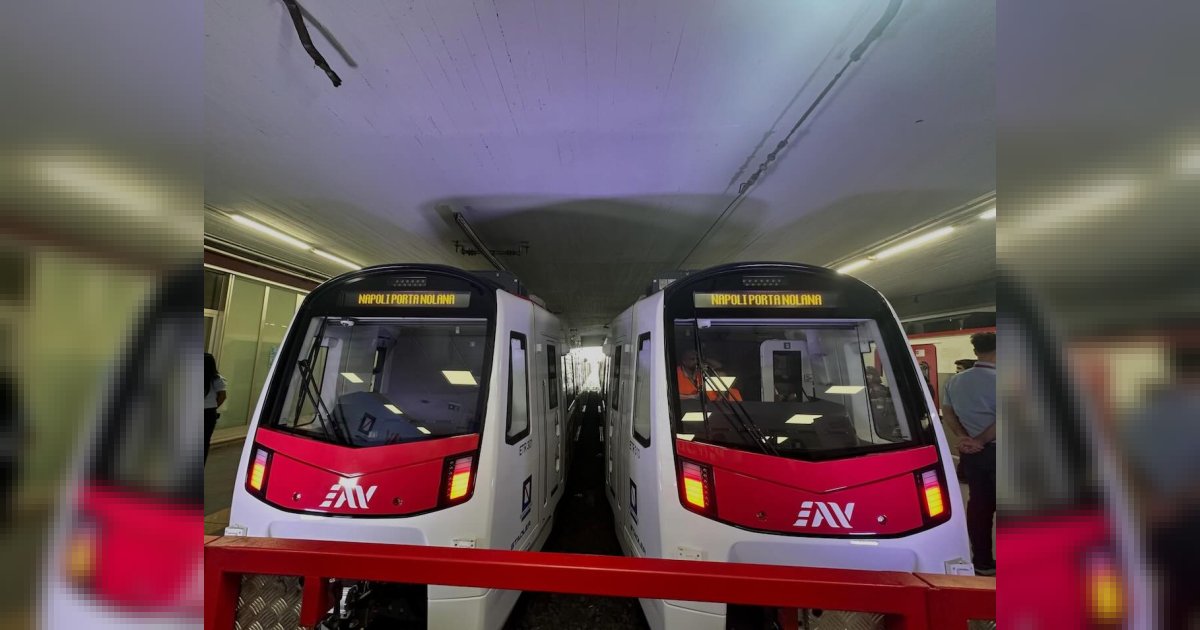
the new Circumvesuviana trains
The announced turning point for the Circumvesuviana has a precise date: October 17th. From that day, the new operating program for the Vesuvian Lines will come into effect, presented at the EAV Porta Nolana station in the presence of the President of the Campania Region, Roberto Fico, the Vice President with responsibility for Transport, Mario Casillo, and the Sole Director of EAV, Pietro Diamantini.
The key point of the plan is to move from the previous 36-minute frequency to a standard 30-minute frequency. This isn't just about increasing the number of trains, but also making the service more recognizable: departures will be organized according to recurring schedules, the same minutes throughout the day, with the aim of allowing passengers to more easily memorize schedules and plan their journeys without having to consult the departures board each time.
It's the mnemonic timetable model, a formula aimed at reducing uncertainty for commuters, students, workers, and tourists. The promise is a more readable and regular Circumvesuviana. Verification, however, will only come with the daily implementation of the new plan: a regular timetable can simplify organization, but its effectiveness will depend on the company's ability to ensure compliance and ensure sufficient vehicle availability.
According to data presented by the Region and EAV, the total number of daily services will increase to 280, with 39.872 seats and a total of 171.988 seats available each day. Daily kilometers traveled on the Vesuvian network will exceed 9.300.
In detail, the new program includes:
- 68 daily trips on the Naples-Sorrento route.
66 races on the Naples-Torre Annunziata line.
58 races on the Naples-Poggiomarino line.
60 trips on the Naples-Sarno line.
28 races on the Volla-Baiano line.
On the Naples-Sorrento line, 34 direct trains are scheduled in each direction, with stops at San Giorgio a Cremano, Portici, Ercolano Scavi, Torre del Greco, and Torre Annunziata. The estimated travel time is approximately 75 minutes. On the Naples-Torre Annunziata and Naples-Poggiomarino lines, 33 and 29 accelerated trains will be activated in each direction, respectively.
The program also aims to strengthen connections in the Vesuvian area. A total of 192 trains are scheduled daily between Naples and Torre Annunziata, with a train every ten minutes serving San Giorgio a Cremano, Portici, Ercolano Scavi, and Torre del Greco. On the Naples-Sarno line, there will be 30 accelerated trains in each direction, while the connection to Poggiomarino should be guaranteed every 15 minutes via both routes, via Scafati and via Ottaviano. Finally, on the Volla-Baiano line, 14 accelerated trains are scheduled in each direction.
Ten ETR 300s in service
The new model will be supported by ten new ETR 300 electric trains, which will gradually enter service by October 17. The convoys are part of a total supply of 56 trains: the first ten will be followed by another 46 vehicles currently in the supply phase.
For the Region and EAV, the introduction of the new trains represents one of the most important steps in the network modernization program. The new generation of trains was designed to increase rolling stock availability, reduce breakdowns, and streamline maintenance.
The equipment listed also includes active video surveillance systems, presented as a tool to improve safety on board.
The real unknown, however, isn't just the age or technical characteristics of the trains. The key will be the ability to transform the availability of the new trains into service continuity. For years, the Vesuvian lines have been problematic not only because of the quality of the rolling stock, but also because of breakdowns, cancellations, delays, organizational shortcomings, and infrastructure difficulties. The new plan will therefore have to address the daily routines of the stations and the needs of those who use the Circumvesuviana out of necessity, often without alternatives.
Trains and buses on the Sorrento Peninsula
The project doesn't just concern the rail network. A significant portion of the new program is dedicated to integrating trains and buses in the Sorrento area, with the goal of improving connections at the Sorrento and Vico Equense stations.
The 008 Meta-Massa Lubrense bus line will increase its frequency from 20 to 15 minutes. The 009 lines, which provide circular service to Vico Equense, will increase their frequency from 30 to 15 minutes, substantially doubling their frequency.
Reducing wait times should benefit both residents and tourists, especially when connecting train stations to coastal towns. The stated goal is to create a network in which rail and road are not separate services, but rather parts of a single mobility system.
"A modern transportation system can't be just trains. It must be a network where rail and road communicate," explained Pietro Diamantini during the presentation, citing integration between the various means of transport as one of the key elements of EAV's new phase.
The promises and the trials of commuters
"Today we are taking an important step towards concretely improving public transport on the Vesuvian Lines," said Roberto Fico. The regional president highlighted the arrival of the ten new trains and the introduction of a "simpler and more regular" timetable, while admitting that "there is still much work to be done."
"Citizens' right to mobility is a fundamental point," added Fico, calling the new program a further step in the process of relaunching regional mobility.
Mario Casillo quantified the increase compared to 2025: "The first concrete step towards citizens is the 56 additional journeys." For the regional vice president, the new setup should ensure "a more reliable service, with more journeys and reduced wait times," as well as strengthening the connection between trains and buses.
Diamantini, however, described the plan as the start of a new phase in the company's operations: "It's not simply a new train schedule, and it's not just new trains." According to the sole director, EAV will have to gradually change the way it builds its offering, putting the customer and the needs of those who use the train to get to work, university, school, the hospital, or to an appointment at the center.
The statement also contains the main criteria for evaluating the new schedule: not just the number of announced journeys, but their actual usability. For passengers, an extra train is worth little on paper if it's later canceled, delayed, or overcrowded.
Energy efficiency and sustainability
The ETR 300 trains are also presented as advanced environmental and energy-efficient vehicles. The project draws on the principles of European Regulation 2020/852 and the DNSH criterion, which stands for "Do No Significant Harm," according to which interventions must contribute to sustainability objectives without causing significant damage to the environment.
Regarding materials, they are rated at 85 percent recyclability and 95 percent overall recoverability. The drive system achieves a declared efficiency of approximately 89 percent. During braking, the energy produced is recovered and reintroduced into the system, contributing to reduced fuel consumption.
The trains are also equipped with instruments to measure and monitor the energy used by the traction system. Intelligent power management functions should help limit waste and optimize the vehicle's overall efficiency.
However, these are design performances that will also need to be evaluated in actual operation. The train's technical efficiency is only one element of the environmental and management balance sheet: the actual frequency of runs, maintenance, the number of cancellations, and the ability to maintain service over time also play a role.
The challenge of continuity
EAV's new plan seeks to address three key areas simultaneously: more trains, more journeys, and greater integration with road transport. The announced numbers are significant, as is the investment in fleet renewal. But the real test will be the gap between the program presented at Porta Nolana and the day-to-day experience at the stations.
Starting October 17, commuters and travelers will be able to verify whether the 30-minute train schedule will actually be maintained, whether the new trains will reduce breakdowns and cancellations, and whether connections with buses on the Sorrento Peninsula will function without further delays.
The timetable change, therefore, isn't just a technical issue. It's a promise of reliability for the thousands of people who every day entrust their work, studies, appointments, and travel between Naples, the Vesuvian area, and the Sorrento Coast to the Circumvesuviana.
Breaking News
ISFF 2026: Stabia in Frame, the contest dedicated to young filmmakers, is born.
ISFF 2026 in Castellammare di Stabia (November 23-28, 2026) inaugurates Stabia in Frame, Young Video… Read more
Guided tours of the Herculaneum Suburban Baths are back, running from October to December 2026.
Guided tours of the Suburban Baths construction site will return from October 2026… Read more
Naples, young drug dealer arrested in Mianella
Naples - Yesterday morning, the State Police arrested a 24-year-old for illegal possession… Read more
Pompeii, a 66-year-old man from Castellammare dies after being hit on the crosswalk. The hit-and-run driver has been identified.
Castellammare - A walk with her husband turned tragic. She was going through… Read more
Fire in Giugliano: monitoring of airborne dioxins underway
Arpa Campania has activated monitoring of dioxins, furans, and dioxin-like polychlorinated biphenyls in the air following… Read more
An elderly woman flees at breakneck speed between Tuscany and Umbria: two Campanians arrested
Arezzo,— A reckless drive on the E45, dangerous maneuvers in traffic, and a stampede… Read more

National Newspaper
Registration No. 1301 of 2016 – ROC 030531
Director: Giuseppe Del Gaudio
To contact the editorial staff click HERE |
Download our Official ANDROID APP