Amalfi and the Valle delle Ferriere: Neapolitan pastiera amid citrus fruits, water, and trails.
Among the terraces of the Amalfi Coast and the lush vegetation of the Valle delle Ferriere, Neapolitan pastiera tells the story of a Campanian spring made of wheat, ricotta, and the scent of oranges.
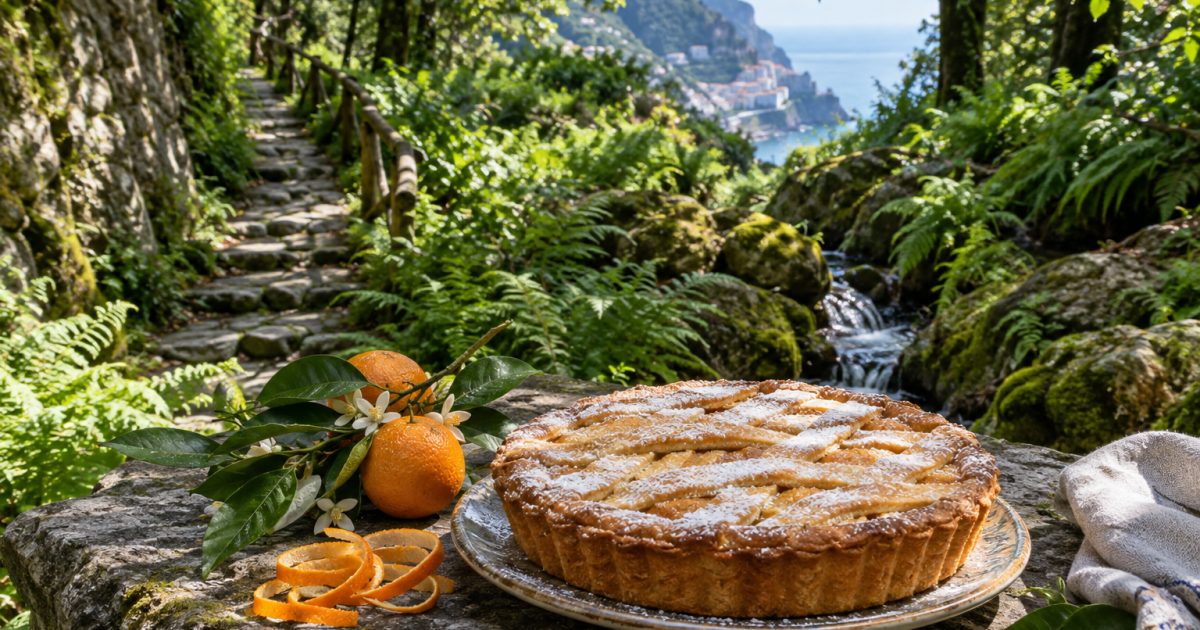
In the image, a detail related to the story.
In Amalfi, the path to the Valle delle Ferriere leads past citrus trees, streams, and green cliffs: a landscape that finds its springtime dessert in the Neapolitan pastiera.
The Ferriere Valley, between water and vegetation
The Valle delle Ferriere lies behind Amalfi, in a secluded setting where water has shaped the terrain and maintains particularly lush vegetation. The trail can be reached via the routes connecting Amalfi, Pontone, and Scala, which include uphill stretches, steps, and uneven terrain. Before setting out, it's a good idea to check trail conditions, access, and local signs, especially after heavy rain.
The landscape gradually changes. From houses clinging to the slopes and cultivated terraces, one moves to a more shady landscape, marked by streams, waterfalls, and rock faces. The greenery is uneven: ferns, mosses, and woodland trees create a refreshing backdrop, while further down, the light of the Amalfi Coast once again meets the citrus groves and the outline of the sea.
Here, the relationship with food isn't born from a single, exclusive valley product, but from the way the Campania region connects diverse environments. Pastiera is a traditional Neapolitan dish, yet its ingredients evoke many images of the region: wheat from the fields, ricotta from inland areas, citrus fruits grown on the coastal slopes, and orange blossom water used sparingly.
After a walk, this dessert lends itself to a slow break. Its texture isn't light in the modern sense of the word: it's soft, moist, and fragrant, with the barely perceptible resistance of the wheat grains. The shortcrust pastry shell adds a crumbly note, while the ricotta holds together the creamy texture and the aromas of the herbs.
The Neapolitan dessert that smells of spring
Pastiera is primarily associated with the Easter season, but its seasonality extends beyond the holiday. In its most recognizable version, cooked wheat meets ricotta, eggs, sugar, candied fruit, and orange blossom water. Preparation requires time and rest: when fresh from the oven, it's still too fragile, and the flavors aren't fully blended.
For a 24-centimeter round pan, use 300 grams of flour, 150 grams of butter, 120 grams of sugar, and two egg yolks for the pastry. For the filling, use 250 grams of cooked wheat, 250 grams of well-drained ricotta, 200 grams of sugar, three eggs, 50 grams of candied orange peel, the grated zest of one unwaxed lemon, a teaspoon of orange blossom water, and, to taste, a small amount of cinnamon.
The pastry should be worked quickly, without overheating it, then wrapped and left to rest in the refrigerator. Meanwhile, the wheat can be softened in a pan with a little milk and a knob of butter until it becomes a thick but not runny cream. It's important to let it cool before adding it to the other ingredients.
The ricotta should be pureed or blended with sugar until smooth. Then, add the eggs one at a time, along with the cooled wheat, candied fruit, lemon zest, cinnamon, and orange blossom water. The orange blossom water should be distinct but not overpowering: too much would overwhelm the flavor of the ricotta and citrus.
The rolled out shortcrust pastry lines the buttered pan, leaving a regular edge. Pour the filling in, but don't go all the way to the rim, as it tends to swell during baking. Cut the remaining pastry into thin strips and arrange them in a grid pattern. Bake in a conventional oven at about 170-180°C (340-350°F) for an hour, checking the surface for color and the center for firmness. The pastiera should be golden brown and still slightly wobbly in the center.
The crucial step comes after baking. Once cooled, the pastiera should be left to rest at least overnight, or even better, a whole day. The pastry will absorb some of the moisture, the filling will firm up, and the orange blossom scent will be more harmoniously distributed. Powdered sugar, added just before serving, provides a subtle finishing touch.
From the path to the table, the same idea of balance
The Valle delle Ferriere suggests a different pace than the more popular scenic spots along the coast. The sound of the water muffles the sound of the road, the shade reduces the light, and the climb forces you to observe the terrain step by step. Pastiera, with its slow pace, follows the same logic: it's not a dessert to be consumed in a hurry.
The connection between Amalfi and Naples is thus based on textures and aromas, not a forced overlap. The city of Naples offers pastiera its most recognizable identity; the Amalfi Coast complements it with the tangible presence of citrus fruits, terraced fields, and a landscape where water and stone coexist.
For those visiting the area, the most respectful choice is to dedicate time to both the trail and the meal, wearing suitable footwear, paying attention to the elevation changes, and avoiding picking plants or flowers along the way. At the end, a slice of pastiera served at room temperature recreates, in a homely form, what the valley had suggested: the contrast between the coolness of the forest and the Mediterranean light, between the soft wheat and the crumbly pastry, between the Campanian interior and the sea that reappears between the slopes.
Breaking News
Naples: A 27-year-old man escapes house arrest and is found with cocaine and crack cocaine.
Naples - He was under house arrest, but when the police checked him… Read more
Salerno: 26-year-old arrested with drugs, weapons, and homemade explosives in his home
In Montecorvino Rovella, the Carabinieri arrested a 26-year-old following a search that… Read more
Serial thefts in Benevento: A woman arrested for having stolen clothes, accessories, and cell phones.
Benevento - A woman has been arrested by the State Police on serious suspicion of a… Read more
Ercolano, explosion at the barrel factory: Pasquale Punzo sentenced to death
The appeal in the Ercolano illegal barrel factory case has begun in Naples.… Read more
Castellammare, the Prefect blocks a public construction site: "Safety regulations violated."
Castellammare - A surprise inspection led to the immediate suspension of work at a construction site... Read more
Caserta, bottles thrown from the balcony alarm the neighborhood: the Carabinieri find drugs and arrest them.
Caserta – A nocturnal recklessness that turned into a legal own goal. He took the… Read more

National Newspaper
Registration No. 1301 of 2016 – ROC 030531
Director: Giuseppe Del Gaudio
To contact the editorial staff click HERE |
Download our Official ANDROID APP
