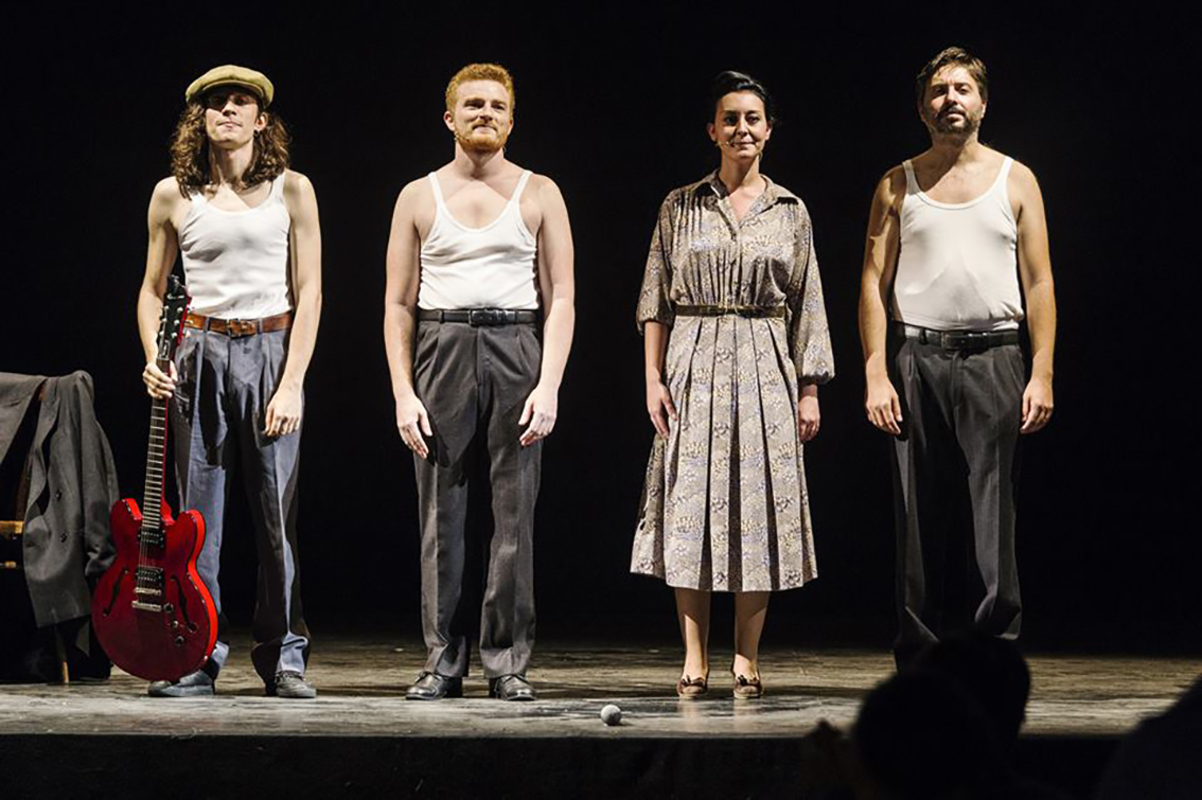
Thursday 3 June at 20.00:XNUMX pm at the Catacombs of Naples, the Live – Theatre is Live series continues with the show Stella Ria, presented by Liberaimago, written and directed by Fabio Pisano, starring Francesca Borriero, Claudio Boschi and Roberto Ingenito.
On stage, the story of Celeste di Porto, the young fatalist who at 18 decided to inform on the Germans in the Roman ghetto. The festival is part of the "Campania è Teatro, Danza e Musica" (Campania is Theater, Dance and Music) program, promoted by ARTEC/Sistema MED in collaboration with SCABEC - Società Campana Beni Culturali and the Fondazione Campania dei Festival. Tickets for events at the Catacombs of Naples cost €5,00. Reservations are required at +39 339 6666426.
Tickets can be purchased at the Catacombs box office on the evening of the show, upon reservation, or in advance on the website https://www.vivaticket.com/it/venue/catacombe-di-san-gennaro/512605050
Stella Ria takes us back to 1925, when Celeste di Porto, the “black panther”, was born in Rome’s Jewish ghetto. She was the beautiful and fatal eighteen-year-old girl who, after the roundup of the Roman ghetto by the Germans led by Kappler, decided to become an informer, to sell out the Jews: her coreligionists. Thus began a truly dark period for the inhabitants of the Italian ghetto. Those who were greeted with a wave of the hand by the woman who was recognized as one of the most beautiful girls in Rome, had no escape. And she didn’t care if those who ended up in the hands of the black shirts were women, children or men. Only her family had to be spared. But Celeste’s father couldn’t bear this enormous weight on his conscience and handed himself over to the SS. Her brothers, including Angelo, whom she loved so much, disowned her. Only her mother continued to love her.

As author and director Fabio Pisano explains : “Celeste is a rare figure, a Jew, a Jew who evidently suffered a triggering of the classic ‘survival instinct’ in her psyche, which drove her to commit horrific acts against her people. Ruthless, yes, and this show has no claim to absolve her, but to narrate. To recount what she did, trying to imagine why, or even invent it. Because some stories leave no trace, except a writing on the wall of a prison cell. A writing carved with a nail. And with all the anger of those who don't know. The unawareness of those who are in the dark. Well, by shedding light coherently, therefore following the voice of an uncomfortable but real character, we set ourselves the goal of a story. Of a narrative that goes, tenuously, to slip into the enormous, boundless archive of a historical period that will be remembered as a sick period.”
Read also here