When international cooperation becomes uncomfortable

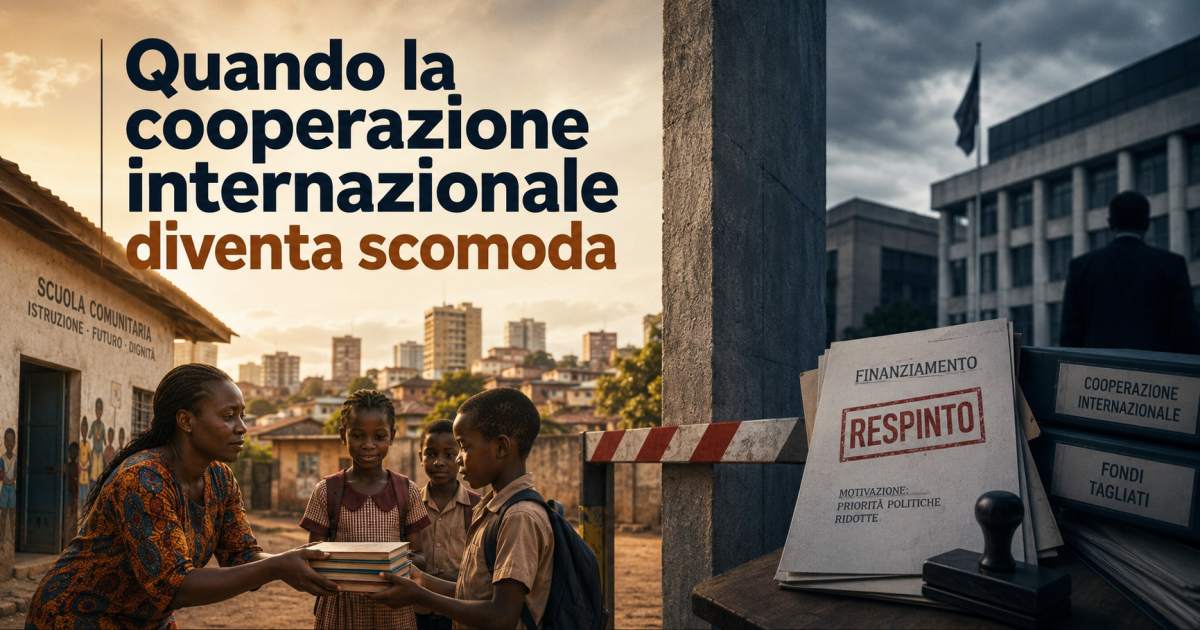
In the photo, a detail of the story.
It's a provocation, of course. But perhaps not so much.
Because talking about international cooperation today means entering a much more complex field than it might seem. The world has changed, the balance of power between states has shifted, political priorities have shifted, and, above all, the sensitivity with which we view those who continue to work every day in the planet's most fragile areas seems to have changed.
It's easy to say we need to help the poorest populations. Everyone does it.
It's said at conferences, in political programs, in institutional campaigns. We talk about solidarity, development, inclusion, rights, education, and the fight against poverty.
But then, we need facts.
And it is precisely when the facts arrive that the problems very often begin.
When a project works but the funds run out
For example, we've heard of organizations that have been working in Africa for years. After building projects, building relationships with local communities, and achieving concrete results, they've been denied the funding they need to continue their work.
And this is where an inevitable question arises: how can a project considered useful for years suddenly become less worthy of support?
Naturally, each call for proposals has its own rules, each funding has specific criteria, and no association can automatically renew a public grant.
But when a request for support is backed by years of experience, people helped, children supported through school, facilities built, or communities supported, reflection becomes necessary.
Because interrupting a cooperation project doesn't simply mean removing an item from a budget.
It means risking interrupting human paths built over time.
The politics of priorities
And it is precisely here that international cooperation risks becoming, in some ways, inconvenient.
Uncomfortable because it requires continuity.
Inconvenient because results don't always arrive within the timeframe of a single legislature.
It's inconvenient because truly helping a local area means staying present for years, without being able to turn every intervention into a slogan.
Serious cooperation does not thrive on photographs, ceremonies, or declarations.
It thrives on schools that continue to operate after the cameras have gone. It thrives on children who are cared for over time, on families who are supported, on trained local workers, and on communities that are slowly becoming autonomous.
And that's exactly the point.
Cooperation cannot be evaluated solely by following the political expediency of the moment.
Do children and stepchildren still exist?
The feeling, looking at certain choices, is that even in solidarity there can be children and stepchildren.
There are projects that manage to attract attention, funding, and visibility, and others that, despite producing significant results, suddenly struggle to find support.
Not necessarily because they are less valid.
Sometimes simply because priorities have changed.
And it's legitimate for a state to set its own priorities. But it would be equally important for these choices to be accompanied by transparency, clear assessments, and above all the ability to distinguish between a one-off project and an entity that has been operating in the region for many years.
Because behind those associations there are not just acronyms.
There are volunteers, aid workers, priests, teachers, doctors, workers, and citizens who have often dedicated a significant part of their lives to those projects.
The “Third World” no longer exists as we imagined it.
There is another element that deserves attention.
For decades we have used the term Third World to indicate a part of the planet that is poor and dependent on the West.
Today that definition increasingly reflects reality.
Africa, for example, has become one of the great geopolitical battlegrounds of our time. China, Russia, the United States, Europe, Turkey, and the Gulf countries are increasing their economic, diplomatic, and strategic presence on the continent.
This means that international cooperation can no longer be seen solely as charity.
It's also about building relationships, trust, and international presence.
When Europe retreats, someone else inevitably occupies that space.
Helping means above all being there
This is why the way we talk about cooperation should also change.
It's not simply about "giving money to Africa," as the discussion is too often trivialized.
True cooperation means creating conditions so that a community can grow on its own.
It means education.
It means training.
It means health.
It means access to water.
It means child protection.
It means creating economic opportunities.
And it is precisely continuity that makes the difference.
A project that lasts ten years can change a generation. A project that lasts twelve months can become merely a parenthesis.
Cooperation cannot be a slogan
The initial provocation, then, remains.
When does international cooperation become uncomfortable?
Maybe when it stops being a nice word to be inserted into programs and starts asking for concrete commitments.
When you have to choose whether to finance a school again.
When you have to decide whether to continue caring for children who would otherwise end up back on the streets.
When it's necessary to ensure continuity for those who have worked in the area for years.
It is precisely at that moment that real political will is measured.
Because solidarity is easy when it costs little.
Cooperation, on the other hand, requires responsibility.
And if we truly believe that helping the most vulnerable populations is a value, then we can't only remember it when it's convenient to talk about it.
We have to be there even when it gets difficult.
And, above all, when it becomes uncomfortable.
Breaking News
Naples' Piazza Mercato is at the mercy of gangs who speed by on scooters and challenge the Army.
A night of chaos and lawlessness in the heart of Naples, where Piazza Mercato is transformed once again... Read more
Sannio Runners Dropexpress takes center stage in Ariano Irpino with prizes, personal bests, and team spirit.
🏃♂️🏃♀️ 11 athletes from Sannio Runners Dropexpress present in Ariano Irpino, in a race organized… Read more
The reasons for Allegri's Napoli collapse at the Meazza
Yesterday's match was one of those matches that leaves a bitter taste in the mouth; The… Read more
- Amalfi Coast
- Chain drive
- live,
- Live
- First floor
- Salerno and Province
- Socials
- Stories
- Breaking News
- zoom meeting
Tragedy on the Amalfi Coast: Man dies at sea in front of his children
A quiet late summer Sunday turned into a drama on the beaches of the Amalfi Coast… Read more
Giugliano: Large fire in Taverna del Re: Eco-bales site engulfed in flames
Giugliano – A large fire broke out this afternoon inside the storage site… Read more
A diving tank explodes on a rubber dinghy, injuring a diver in Procida.
Procida – A loud bang, then an explosion, and fear in the sea. He was injured… Read more

National Newspaper
Registration No. 1301 of 2016 – ROC 030531
Director: Giuseppe Del Gaudio
To contact the editorial staff click HERE |
Download our Official ANDROID APP